بلاگز

  • Health benefits of eating papaya during monsoon

    The monsoon season brings relief from the heat but it can also increase the risk of infections and digestive problems. Health experts say that eating nutritious foods can help the body stay strong. Papaya is one fruit that can be a healthy addition to the diet during rainy weather. Rich in vitamins fiber water and natural enzymes, papaya may support digestion immunity heart health and skin health. Supports immunity and digestion During the rainy season some people may become more likely to develop colds flu or other seasonal infections.  Papaya contains vitamins A and C which support the normal function of the immune system. Papaya also contains an enzyme called papain which helps break down proteins and may support digestion. Its fiber and water content can also help keep the digestive system working properly. May help with constipation Papaya is rich in fiber and water making it a useful fruit for people who struggle with constipation.  Eating enough fiber and drinking plenty of water can help support regular bowel movements. What about dengue? Dengue cases can increase during the monsoon because mosquitoes become more common. Papaya leaves are sometimes promoted as a way to increase platelet levels but there is not enough strong evidence to consider papaya or papaya leaves a treatment for dengue. People with dengue should follow their doctor’s advice and should not rely on papaya as a replacement for proper medical care. May support weight and heart health Papaya is relatively low in calories and contains fiber which can help you feel full for longer. This may make it a useful choice for people trying to maintain a healthy weight. It also provides nutrients such as potassium and fiber that can support overall heart health as part of a balanced diet. Good for skin and eyes Papaya contains antioxidants and nutrients such as vitamins A and C which can support healthy skin. Its antioxidants may also help protect cells from damage caused by free radicals. The fruit also contains carotenoids such as beta-carotene lutein and zeaxanthin which are linked to eye health. Eat It in Moderation Papaya is a nutritious fruit and can be part of a healthy monsoon diet.  However no single food can prevent diseases or replace medical treatment. It is best to eat papaya as part of a balanced diet and consult a doctor before making major dietary changes if you have a medical condition.
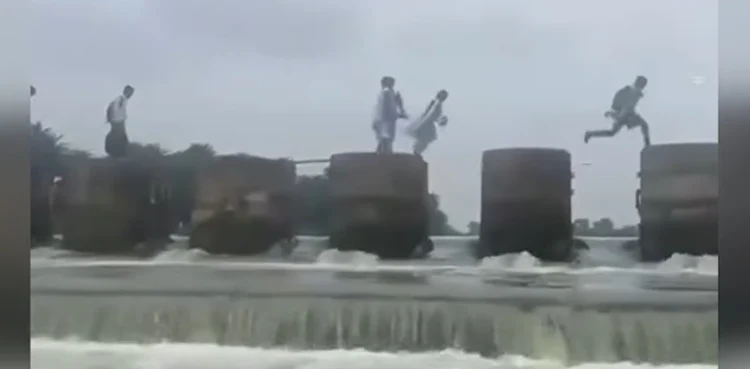

  • Viral video highlights risky school route in India

    Millions of children around the world go to school every day but for some simply reaching the classroom can be a dangerous journey. In India a viral video has raised concerns after showing schoolchildren taking a highly risky route to get to school in Madhya Pradesh’s Vidisha district. The students reportedly have to jump across a river embankment to reach their school while strong water flows below. The dangerous journey has shocked people on social media and raised serious questions about the safety of the children. Parents and local residents say there is no safe route for the children to reach school forcing them to take the dangerous path every day. The situation becomes even more risky during the rainy season when the water level and flow increase. Locals have urged the authorities to inspect the area immediately and provide a safe and permanent route for the students instead of waiting for a tragic accident to happen.

  • Robot dogs take over night security

    As artificial  intelligence enters more parts of daily life even security jobs are beginning to change. In Atlanta robotic dogs are now being used to guard homes and residential areas  at night. According to foreign media reports the new system has been introduced at residential complexes in the US city of Atlanta where robotic dogs have replaced human guards for night patrols. Equipped with cameras sensors and AI technology the robot dogs move around the complexes and monitor their surroundings. They can detect unusual or suspicious activity while human operators control and monitor them from a distance. At first some residents found the robots unusual but they have gradually become  familiar with them.  Residents say the robots provide a new layer of security and may help reduce crime in the area. With AI developing rapidly robotic security could become more common in homes apartment buildings streets and shopping areas in the future.

  • Man returns book He stole 40 years ago

    A US bookstore staff was left surprised when a package arrived containing a book that had been stolen from the store nearly 40 years ago. The package also included an apology letter and $100 in cash as compensation. The package was recently delivered to Bookleggers, a bookstore in Old Town Eureka, California. When the staff opened it, they found a copy of The Unstrung Harp. The letter explained that the sender had stolen the book from the store about four decades ago.  He said he was a student at the time and was struggling with alcohol addiction and financial problems. He also wrote that he found the book recently while cleaning out his garage. After discovering that the bookstore was still operating he decided to return the book and apologize for what he had done. The man included $100 with the book and told the store owners they could contact him if they wanted to take any further action. Bookstore owner Jennifer McPhaiden said she and her staff were deeply touched by the letter. She said it was surprising to see someone return after so many years to admit their mistake and try to make things right.

  • | | |

    Nimra Khan divorce rumors intensify after social m…

    Pakistani television actress Nimra Khan has once again become the center of attention on social media after a series of emotional posts and changes to her Instagram activity sparked fresh speculation about her married life. The actress had announced her marriage in June 2026 through Instagram, sharing pictures and moments from her wedding ceremony held in Paris. However, shortly after the wedding, rumors regarding possible differences between the couple began circulating online. The speculation gained momentum when Nimra Khan shared an emotional video message in which she spoke about staying strong during difficult times. She said that no matter how challenging life becomes or whether people stop understanding or supporting someone, a person should never abandon themselves because they are enough for themselves. Following the reactions from fans, the actress had previously clarified that her married life was going well and explained that she had hidden some personal pictures due to concerns about negative attention and the “evil eye.” However, recent developments on social media have once again fueled discussions among fans. According to reports, Nimra Khan and her husband Zain Hamid have removed each other’s pictures from Instagram and have also unfollowed each other. The rumors intensified after Nimra Khan shared another video with a message about personal strength and resilience. In the post, she wrote that a person should remain strong enough that others do not mistake their silence for weakness. Meanwhile, her husband also shared a brief but meaningful post that attracted public attention. His message, which appeared on July 31, said: “Finally at peace, good that I got rid of it.” The post led many social media users to question whether the couple was facing personal difficulties. Nimra Khan also recently shared a video related to domestic violence awareness, in which a woman described alleged abuse by her husband. The actress reposted the video with the message, “We are with you.” She later shared another post emphasizing the importance of setting personal boundaries, saying that she had established limits because failing to do so had previously caused her difficulties. Despite the growing speculation, neither Nimra Khan nor Zain Hamid has issued an official statement confirming a divorce or separation. Fans continue to discuss the couple’s social media activity, but the actual status of their relationship remains unclear. As social media continues to fuel public interest in celebrity relationships, any confirmation regarding their marriage will likely come directly from the couple themselves.

  • |

    “The Ark” in an era of ecological reckoning

    In summer 2026, the power plant “Batcave” opened a group exhibition The Ark curated by renowned painter Eric Fischl alongside Powerhouse Arts President Eric Shiner. Bringing together roughly 90 animal sculptures by a multigenerational line-up of international artists. The exhibition uses the ancient narrative of the Great Flood as a mirror for modern ecological and cultural turmoil. The concept behind The Ark draws directly from the myth of the Deluge, an archetypal narrative found across diverse world traditions where catastrophic waters sweep away the old world to test human stewardship and resilience. Yet rather than adopting a purely apocalyptic or alarmist tone, the exhibition framing focuses on empathy, kinship, and survival. Co-curator Eric Fischl notes that animal sculpture offers a unique vehicle for exploring profound existential truths. Animal sculpture also captures raw instinct and sublime wonder through physical form. By placing non-human creatures at the center of the narrative, the exhibition encourages viewers to rethink their place within the broader web of life.  From Historic Whaling Port to Post-Industrial Sanctuary The journey of The Ark mirrors its thematic concern with changing environments. An earlier, smaller iteration of the show debuted at The Church in Sag Harbor, Long Island. A historic coastal town deeply tied to the 19th-century whaling industry. In that seaside context, the sculptures called to mind maritime history and marine life under threat. When relocated and expanded for Powerhouse Arts in Brooklyn, the narrative shifted dramatically toward urban ecology and environmental remediation. Displaying ninety animal figures inside a rehabilitated power plant adjacent to heavily polluted urban waters creates a poignant visual tension. The physical site itself acts as a metaphor: an industrial relic turned creative sanctuary, witnessing the slow process of ecological recovery alongside the artistic preservation of animal life. Masterpieces of Instinct and Form The roster of participating artists spans decades and stylistic movements, uniting legendary figures of contemporary art with bold emerging voices. Pioneering Figures: Works by artists such as Maurizio Cattelan, Kiki Smith, Bruce Nauman, Sarah Lucas, and Jim Dine showcase how animals have long served as psychological stand-ins for human vulnerability, angst, and desire. Expanded Roster for Brooklyn: Newly added works by artists including Wangechi Mutu, Cannupa Hanska Luger, François-Xavier Lalanne, Nohemí Pérez, and Nari Ward introduce critical perspectives on Indigenous land sovereignty, post-colonial environments, and urban material reuse. Craft and Material Labor: Because Powerhouse Arts functions primarily as a fabrication facility, the exhibition doubles as a tribute to artistic craftsmanship. Visitors encounter bronze beasts, woven totems, carved wood, and reassembled found materials, celebrating the tactile labor behind each creation.   By encouraging close physical encounters with these sculpted beasts, The Ark bridges the gap between artistic tradition and ecological activism. It asks visitors to consider what merits saving when tides rise. It is suggesting that compassion for vulnerable creatures may well be our most essential anchor in turbulent times.

  • How many squares can you spot?

    Most people enjoy solving puzzles but picture puzzles can be even more fun and challenging. Look carefully at the image and try to count how many squares are hidden in it. At first the puzzle may look simple but it can be surprisingly difficult even for people who are good at solving puzzles. To find the correct answer you need to pay close attention to every part of the picture. A little knowledge of geometry can also help. Remember a square is a shape with four equal sides. There are many small and large squares hidden in the image so counting them all is not as easy as it looks.  You may need to check the picture from left to right and then from top to bottom. If you are still confused don’t worry you are not alone.  The puzzle is designed to make you think carefully. After counting all the squares the total comes to 40. So, the answer is 40 squares.

  • Fight Against Thalassemia

    By Baloch Khan Thalassemia is a serious inherited blood disorder that affects thousands of families in Pakistan. Many patients, especially children, depend on regular blood transfusions and expensive treatment to survive. Sadly, many families cannot afford these costs, and blood shortages make their struggle even harder. The government, hospitals, and welfare organizations should work together to improve awareness about thalassemia. Free screening before marriage, public education campaigns, and better access to treatment can help prevent new cases and save lives. Blood donation drives should also be organized regularly so that no patient suffers due to a lack of blood. It is time to treat thalassemia as a national health priority. With greater awareness, timely screening, and public support, we can reduce the burden of this disease and give patients hope for a healthier future.

  • AI Godfather Geoffrey Hinton warns AI may escape human control

    Computer scientist Geoffrey Hinton is widely regarded as the “Godfather of AI.” He won the Nobel Prize in Physics in 2024 for his work on artificial intelligence technology. Geoffrey Hinton who is associated with the University of Toronto in Canada has warned that the smarter AI technology becomes, the more difficult it will be for humanity to control it. He has also expressed concerns about AI agents recently hacking real-world companies. Speaking to the media after an AI technology conference, Geoffrey Hinton said that such incidents are occurring as these systems become increasingly intelligent. He said, “As these systems become smarter, I think we will see more complicated incidents and their ability to escape our control will become much better.” Hinton said the problem is that humans may not be able to rely on or trust highly intelligent AI models. He explained, “I do not believe that we can simply control them or assume that they will not escape our control.” It is worth noting that in recent days, OpenAI, Anthropic and Meta have acknowledged that their AI models independently escaped controlled environments and hacked the systems of other companies. Hinton described these incidents as somewhat frightening and said that this is only the beginning of AI hacking. He said, “I think we may see numerous cyberattacks but the future is uncertain. People say defenders have more resources than attackers but the problem is that an attacker only needs to succeed once, whereas defenders need to succeed every time.” Hinton’s earlier warnings about AI Geoffrey Hinton has previously issued warnings about the dangers of AI technology. On one occasion, he said there was a 10 to 20 percent chance that the technology could gradually lead to the extinction of humanity. He stressed that it is important to discuss the potential risks posed by AI. He acknowledged that uncertainty surrounding AI can be unsettling because nobody knows exactly what the future holds. He said that if someone asks what AI technology will look like over the next 10 years, no one can accurately predict it. Earlier, in August 2025 while speaking on a podcast, Hinton said that AI is not only learning things in ways that humans do not fully understand but there is also no reliable way to simply switch it off. Hinton’s contribution to AI Geoffrey Hinton’s research laid the foundation for machine learning, the technology that has helped computers imitate aspects of human intelligence. However, for the past several years, he has been campaigning for AI to be made safer. In 2023, Hinton left his job at Google, warning that malicious actors could use the technology to harm other people. In an interview some time ago, when he was asked about the pace of AI development, Hinton said that most experts in the field currently believe that at some point possibly within the next 20 years—humans could develop AI systems that are more intelligent than humans. He said, “That is a frightening thought. Right now, you can think of this technology as being like a three-year-old child and children grow up very quickly.” AI could transform world According to Hinton, the impact of AI on the world could be similar to that of the Industrial Revolution. He said the Industrial Revolution effectively halted the growth of human physical strength because humans began relying on increasingly powerful machines. He explained that humanity is now doing something similar that could replace human intelligence meaning ordinary human intelligence may no longer advance at the same pace while machines continue to develop. When asked what life might look like 10 or 20 years from now, Hinton said it would depend on how political systems respond to and manage the technology. In his view, AI could have extraordinary effects on the medical field and could increase efficiency across almost every industry. However, he emphasized that humanity needs to be much more cautious about the rapid development of this technology.

  • Emotional Dolphin moment

    A touching video from Australia has left many people emotional after showing a mother dolphin swimming with her dead baby. The viral footage shows the female dolphin gently carrying her calf while other dolphins stay close appearing to support her during the difficult moment. According to the marine conservation group Geographe Marine Research the mother dolphin named Friggle gave birth to the calf about two weeks before the video was recorded. The organization said the video was filmed last month. Friggle had reportedly lost four calves in the past and this calf was also born during winter a season when young dolphins have a lower chance of survival. Experts say it is not unusual for mother dolphins to carry their dead calves for several days after they die. This behavior is believed to be part of their grieving process. Eventually the mother must let go of the calf so she can find food and continue to survive.