#art and culture

  • |

    Alliance Française de Lahore exhibits ‘What…

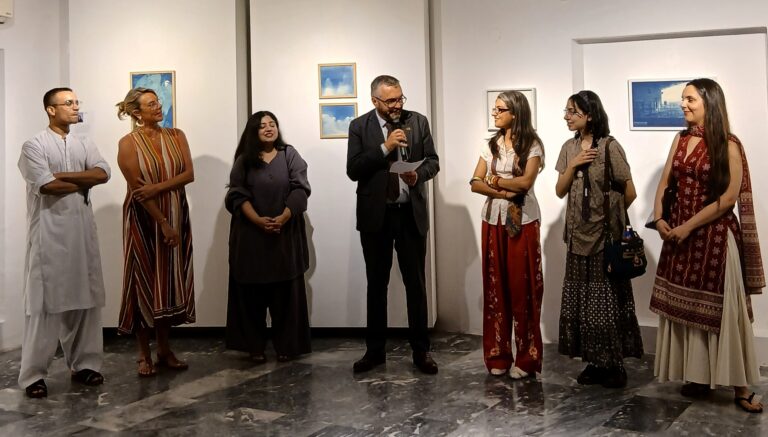
    LAHORE — The gallery at Alliance Française de Lahore opened its doors to art enthusiasts on August 10, 2026. The exhibition presented “What’s Remains”  curated by Anne Sophie Français. The evening paired thought-provoking artworks installations with a lively Kathak dance showcase. The multidisciplinary art offered attendees a rich space and human experience. The art exhibition was curated as a inquiry into what lingers after a place is traversed or a voice is silenced. “What’s Remains“ features new works by three emerging Pakistani visual artists: Rabya Khalid, Sarim Syed and Yumna Salman. They worked across diverse mediums ranging from cyanotypes and charcoal drawings to intricate textile sculptures. Rabya Khalid anchors her compositions in rich cyanotype blues overlaid with soft pastels and color pencils. Rabya focuses on urban architectural features. Water towers, elevated rooftops and quiet watchtowers dominate her skyline studies. Her works cast functional city infrastructure as silent or watchful witnesses to human activity. Sarim Syed utilized delicate charcoal rendering. Sarim creates dreamlike, atmospheric landscapes that occupy the boundary between remembering and forgetting. Her works evoke the lingering sensation of places once inhabited, capturing moments suspended between presence and absence. Yumna Salman brings a tactile, social critique to the gallery space. Yumna knots loose threads onto rigid metal wire mesh. Her labor-intensive textile installations reinterpret traditional weaving techniques to question inherited social norms, gender roles and collective memory. She turned each deliberate knot into an act of quiet resistance. Following the gallery preview, the evening changed into a vibrant 7:30 PM Kathak performance. The performance featured dedicated dance students. They celebrated an intensive month of rhythm, classical movement and expressive storytelling. The fluid footwork and rhythmic precision of the dancers created a unified dialogue with the silent, lingering themes of the surrounding artwork. Alliance Française de Lahore continues to act as an essential platform for emerging talent. The institution provides artists a non-commercial environment to showcase work, inspire public dialogue and strengthen cultural ties between Pakistani and Francophone creative communities. “What’s Remains” invites viewers to engage with stories that endure through art, memory and movement.

  • |

    Marc Padeu is reimagining renaissance masterpieces

    In the global art world, classical European masterpieces have long held a dominant position in defining sacred aesthetics, grand narratives, and historical gravity. However, Cameroonian visual artist Marc Padeu is challenging this historical monopoly by taking the iconic compositions of Old Masters such as Caravaggio, Diego Velázquez, and Titian. He’s transplanting them directly into the lush, everyday landscapes of rural Central Africa. Padeu’s striking large-scale canvases reimagine classic biblical motifs and European artistic traditions against the backdrop of cocoa plantations and rural villages in Cameroon. Far from being a mere imitation of Western techniques, Padeu’s work represents a deliberate re-centering of world history, spiritual heritage, and local identity. A Dual Spiritual and Cultural Inheritance Born and raised in Cameroon, Padeu grew up navigating two distinct spiritual and cultural realities. The formal structure of Catholic devotion and the indigenous customs of Bamiléké animism. This dual background permeates his paintings, where sacred rituals and everyday agricultural labor exist side by side. In Padeu’s compositions, classical Christian iconography such as the baptism of Christ, the martyrdom of saints or solemn biblical gatherings is integrated into scenes of fieldworkers harvesting cocoa pods along riverbanks. Rather than treating these scenes as contradictory, Padeu views them as a natural reflection of human experience. He points out that the original stories of the Bible were ultimately rooted in the lives of ordinary people engaging in daily, unvarnished labor. Extending the Legacy of the Old Masters When Padeu incorporates the compositions, dramatic lighting, and gestures of European Renaissance masters, his objective is not passive homage or simple satire. Instead, he describes his creative philosophy as an extension of the art historical narrative. By placing Black African figures at the center of classical visual compositions, Padeu reframes European iconographic conventions as a shared human language. His paintings suggest that spiritual gravity, dignity and monumental art belong just as naturally to a Cameroonian cocoa harvest as they do to a 16th-century Italian cathedral. The Art of Patience and Global Recognition Padeu’s meticulous process reflects a deliberate rejection of fast-paced contemporary art production: Deliberate Pace: He completes rarely more than ten paintings per year. Long Incubation: Months are spent conceptualizing each piece before a brush ever touches the canvas. Global Reach: His recent solo exhibition in London highlights his growing prominence on the international stage.   Padeu’s ultimate creative ambition is both subtle and transformative. Rather than shaping his art to explain Africa to Western audiences, his goal is to present the wider world through an African lens. His work offers a perspective rooted firmly in the soils, traditions, and realities of Cameroon.

  • | |

    The immortal king: Gilgamesh

    The Epic of Gilgamesh chronicle a ruler whose reach eclipsed his own era. King Gilgamesh of Uruk was celebrated across the Fertile Crescent for his unmatched strength, towering city walls, and unyielding ambition. He was a mythical hero, two-thirds god and one-third man. The Influence of King Gilgamesh Over ancient kings and foreign lands, his influence was absolute. Monarchs who succeeded him across Sumer, Akkad, and Assyria measured their own majesty against his legacy.  Moreover, those realms seek to embody his wisdom and claim a dominion as legendary as the one he forged before the great waters swept the earth. He Who Saw the Deep.. He saw what was secret, discovered what was hidden, He brought us a tale of the days before the Flood. The Ancient Mesopotamia In recent archaeology, the shadow of Mesopotamia’s heroic past continues to reemerge in unexpected ways. Modern researchers conducting glacial surveys on Turkey’s Mount Ararat have begun mapping shrinking ice fields to retrieve core samples. Historically, Mount Ararat is the high peak linked with ancient flood mythologies.  This pioneering study seeks to extract a continuous chronicle of human activity, ancient agriculture and metal smelting preserved in ice layers spanning thousands of years. The studies offer a direct physical record of the environmental world that ancient Mesopotamian civilizations inhabited. Search For The Unknown This convergence of epic poetry and modern science reveals that the search for what was hidden remains as vital today as it was in antiquity. The ancient scribes etched Gilgamesh’s story into clay tablets. They recorded a hero who traveled to the ends of the earth to seek secrets of mortality and natural catastrophe. The story of the great deluge, brought back by Gilgamesh from the edge of the known world. It functioned both as a sobering warning and as a testament to the fragile line between human pride and nature’s fury. The Truth Today, scientists analyze ice layers and ancient cuneiform archives across the Middle East. Furthermore, we are reminded of the power of memory. Kings and empires inevitably turn to dust. Yet, the insights gathered by those who dare to look into the deep endure across millennia remain forever. Gilgamesh’s journey teaches us that true power lies not in martial conquest or monumental stone. Rather, it’s in the wisdom preserved for generations that follow. True power is a truth as resonant in our modern era as it was in the ancient halls of Uruk.    

  • | |

    Theories behind Shakespeare’s true identity

    For centuries, William Shakespeare has been indicated as the undisputed genius of Western literature. His masterworks, ranging from the tragedy of Hamlet to the romantic drama of Romeo and Juliet, form the bedrock of English theater. Yet, beneath the reverence lies one of the most persistent controversies in literary history. Did a provincial actor from Stratford-upon-Avon actually pen these legendary plays? Was Shakespeare merely a convenient alias for another genius working in the shadows? The Paradox of the Bard’s Background Doubts surrounding Shakespeare’s authorship stem largely from the sharp contrast between his known biography and the astonishing depth of his literary canon. Born in 1564, Shakespeare attended the local grammar school where he learned Latin and basic rhetoric. He never pursued higher education at a university, nor did he ever leave England. In contrast, the plays attributed to him demonstrate an extraordinary mastery of complex subjects. They reveal intimate familiarity with international geography, continental languages, high-stakes royal politics, aristocratic court etiquette, and intricate legal doctrines. In an era before public libraries and widespread travel, skeptic scholars often called Anti-Stratfordians question how a man with limited schooling and exposure to foreign cultures could possess such erudition. This discrepancy has led many to speculate that the real Shakespeare acted primarily as a public frontman. As an actor and shareholder in the Lord Chamberlain’s Men, Shakespeare was well-positioned in London’s theatrical community. High-born courtiers or politically vulnerable figures who wished to write plays may have utilized Shakespeare’s name to publish their works safely. The Leading Candidates Over years, prominent figures from Tudor and Jacobean society have emerged as alternatives for the true authorship. Sir Francis Bacon: A brilliant philosopher, statesman, and pioneer of the scientific method. Bacon possessed the intellectual rigor and courtly insight required to craft the plays. Proponents argue that he’s Lord Chancellor and a government insider. So, Bacon couldn’t openly associate with public theater. It would’ve definitely ruined his political standing and risking royal disapproval. Edward de Vere, Earl of Oxford: Educated at Cambridge, well-traveled throughout Europe, and a celebrated poet in his own right, de Vere fits the profile of an elite playwright. However, a major hurdle for the Oxfordian theory is that de Vere passed away in 1604 several years before iconic plays like The Tempest and Macbeth were produced. Christopher Marlowe: Perhaps the most dramatic theory involves Shakespeare’s contemporary, Christopher Marlowe. A gifted Cambridge graduate and spy for the Tudor government, Marlowe officially died in a tavern brawl in 1593. Skeptics suggest he faked his death to escape charges of heresy and treason, subsequently continuing to write under the pen name William Shakespeare. Notably, the first publications under Shakespeare’s name appeared just weeks after Marlowe’s reported demise. Was the Genius a Woman? The authorship debate extends beyond male nobles to include extraordinary women of the Elizabethan court. Shakespeare’s plays are remarkable for their nuanced, highly capable female characters who defy traditional stereotypes of the era. Two prominent women are frequently cited in authorship theories. Mary Sidney, Countess of Pembroke: An accomplished writer, classical scholar, and major patron of the arts, Sidney hosted a renowned literary salon and authored closet dramas meant for private performance. Emilia Bassano: Born to a family of Venetian court musicians believed to have Jewish heritage, Bassano possessed both international ties and formal education. Her background offers a compelling explanation for the Italian settings and Jewish themes present in works such as The Merchant of Venice. An Enduring Literary Mystery Mainstream academic consensus remains firmly with the man from Stratford-upon-Avon. They pointed to contemporary records, theatrical tributes and historical references. The debate surrounding the Bard’s identity continues to fascinate scholars and theater lovers alike. Whether created by a single self-made dramatist or a hidden collective of noble minds, the plays continue to inspire readers across the globe.

  • |

    “The Ark” in an era of ecological reckoning

    In summer 2026, the power plant “Batcave” opened a group exhibition The Ark curated by renowned painter Eric Fischl alongside Powerhouse Arts President Eric Shiner. Bringing together roughly 90 animal sculptures by a multigenerational line-up of international artists. The exhibition uses the ancient narrative of the Great Flood as a mirror for modern ecological and cultural turmoil. The concept behind The Ark draws directly from the myth of the Deluge, an archetypal narrative found across diverse world traditions where catastrophic waters sweep away the old world to test human stewardship and resilience. Yet rather than adopting a purely apocalyptic or alarmist tone, the exhibition framing focuses on empathy, kinship, and survival. Co-curator Eric Fischl notes that animal sculpture offers a unique vehicle for exploring profound existential truths. Animal sculpture also captures raw instinct and sublime wonder through physical form. By placing non-human creatures at the center of the narrative, the exhibition encourages viewers to rethink their place within the broader web of life.  From Historic Whaling Port to Post-Industrial Sanctuary The journey of The Ark mirrors its thematic concern with changing environments. An earlier, smaller iteration of the show debuted at The Church in Sag Harbor, Long Island. A historic coastal town deeply tied to the 19th-century whaling industry. In that seaside context, the sculptures called to mind maritime history and marine life under threat. When relocated and expanded for Powerhouse Arts in Brooklyn, the narrative shifted dramatically toward urban ecology and environmental remediation. Displaying ninety animal figures inside a rehabilitated power plant adjacent to heavily polluted urban waters creates a poignant visual tension. The physical site itself acts as a metaphor: an industrial relic turned creative sanctuary, witnessing the slow process of ecological recovery alongside the artistic preservation of animal life. Masterpieces of Instinct and Form The roster of participating artists spans decades and stylistic movements, uniting legendary figures of contemporary art with bold emerging voices. Pioneering Figures: Works by artists such as Maurizio Cattelan, Kiki Smith, Bruce Nauman, Sarah Lucas, and Jim Dine showcase how animals have long served as psychological stand-ins for human vulnerability, angst, and desire. Expanded Roster for Brooklyn: Newly added works by artists including Wangechi Mutu, Cannupa Hanska Luger, François-Xavier Lalanne, Nohemí Pérez, and Nari Ward introduce critical perspectives on Indigenous land sovereignty, post-colonial environments, and urban material reuse. Craft and Material Labor: Because Powerhouse Arts functions primarily as a fabrication facility, the exhibition doubles as a tribute to artistic craftsmanship. Visitors encounter bronze beasts, woven totems, carved wood, and reassembled found materials, celebrating the tactile labor behind each creation.   By encouraging close physical encounters with these sculpted beasts, The Ark bridges the gap between artistic tradition and ecological activism. It asks visitors to consider what merits saving when tides rise. It is suggesting that compassion for vulnerable creatures may well be our most essential anchor in turbulent times.

  • | |

    The rise of Alfred, Lord Tennyson

    On August 6, 1809, one of the defining literary voices of the 19th century was born: Alfred, Lord Tennyson. Tennyson came to embody the doubts, solemnity, and romantic ideals of the Victorian era. He served as Britain’s Poet Laureate for more than four decades during the height of Queen Victoria’s reign. Early Brilliance and Sharp Criticism Tennyson’s journey to becoming a beloved national figure was anything but smooth. Raised in a large, tumultuous household by a clergyman father, young Alfred sought escape through verse. His talents surfaced early; while studying at Cambridge, he won the prestigious Chancellor’s Gold Medal in 1829 for his poem Timbuktu. Shortly thereafter, he published early collections containing works such as Mariana and Claribel. These early publications showcased his extraordinary musicality and eye for detail, yet contemporary critics were not entirely impressed. Severe reviews dismissed his work as overly melancholic, affected, and sentimental. The hostility of these early critiques shook Tennyson deeply, prompting a decade-long period of publishing silence. A phase scholars often refer to as his ten years’ silence. Crafting the Masterpieces Rather than abandoning his craft, Tennyson spent those quiet years refining his technique, studying philosophy, and confronting personal tragedy. The sudden death of his closest friend, Arthur Henry Hallam, plunged Tennyson into profound grief. This loss became the catalyst for his most famous masterpiece, In Memoriam A.H.H. Published in 1850, the massive elegy explored faith, mortality, and scientific progress, striking a deep chord with a Victorian public navigating rapid industrialization and societal change. The immense success of In Memoriam transformed his standing almost overnight. That same year, following the death of William Wordsworth, Queen Victoria appointed Tennyson as Poet Laureate. He went on to compose iconic works that defined the national consciousness, including The Charge of the Light Brigade, Ulysses, and his epic Arthurian cycle, Idylls of the King. A Lasting Literary Legacy While early critics painted him as a sentimentalist, history remembers Tennyson as a master craftsman of English rhythm and sound. Lines like; “To strive, to seek, to find, and not to yield” (Ulysses) have woven themselves permanently into the modern lexicon. His ability to blend intimate personal emotion with grand societal themes elevated him from a criticized young poet to an enduring pillar of world literature. Key Milestones in Tennyson’s Career 1809: Born in Somersby, Lincolnshire on August 6. 1829: Wins the Chancellor’s Gold Medal at Cambridge for Timbuktu. 1830: Publishes Poems, Chiefly Lyrical, introducing works like Mariana and Claribel. 1850: Publishes In Memoriam A.H.H. and is appointed Poet Laureate by Queen Victoria. 1854: Pens The Charge of the Light Brigade, capturing national sentiment during the Crimean War. 1892: Passes away at age 83, buried in Poets’ Corner at Westminster Abbey.

  • | |

    Jane Austen letter expressing affection for Mansfield Park

    A exceptionally rare, handwritten letter by legendary 19th-century British author Jane Austen has sold at auction for over $200,000. It has captivated literary historians and devoted readers across the globe. Written in early 1814, the intimate correspondence offers a fascinating glimpse into Austen’s personal thoughts during the final stages of writing her third major novel, Mansfield Park. The manuscript was acquired by a private collector after a competitive bidding battle. It highlights the enduring allure and profound market value of artifacts connected to Regency-era literature. Austen’s Private Collections In the letter, addressed to her beloved niece Martha Lloyd, Austen speaks with characteristic wit and self-effacing humor about her creative process. She candidly reveals The manuscript was acquired by a private collector after a competitive bidding battle. Austen harbored a quiet, tender affection for her newest heroine, Fanny Price. Scholars note that such direct expressions of emotion regarding her own craft are exceedingly rare in Austen’s surviving correspondence, as her sister Cassandra burned a vast majority of Jane’s personal papers following the author’s death in 1817 to protect her privacy. The document’s remarkable physical condition significantly contributed to its staggering sale price. Preserved in a family archive for generations before briefly passing through private collections, the single-sheet letter features Austen’s distinctively tidy, flowing script written in iron gall ink, complete with original wax seal remnants and postal markings from Chawton, Hampshire. Experts from the auction house confirmed the paper’s authenticity through detailed watermarking analysis, verifying that the sheet originated from a paper mill active in England during the Regency period. The Mid-80s Literary Period Beyond its physical preservation, the letter holds immense literary significance because it captures Austen at a pivotal moment in her career. Having spent years refining her craft in relative obscurity, the mid-1810s marked a period of intense productivity and emerging financial independence. Mansfield Park represented a deliberate artistic departure from the sparkling, lighthearted banter of Pride and Prejudice, diving into deeper moral complexity, social critique, and quiet emotional endurance. Austen’s reflection in this letter reveals her awareness of this shift and her defense of a softer, more gentle protagonist. Appreciation for Literary Heritage   The sale underscores a broader resurgence of interest in 19th-century women writers among modern collectors and readers. As public appreciation grows for literary heritage, original items connected to figures like Austen, the Brontë sisters, and Mary Shelley have seen exponential value growth at major international auction houses. For admirers of classic literature, this newly highlighted letter serves as a poignant reminder of Austen’s profound human warmth, proving that centuries later, her words continue to move hearts just as powerfully as her immortal fiction.

  • | | |

    Rabindranath Tagore’s statue in Edinburgh

    The Sandeman House garden in Edinburgh holds a bronze statue of Asia’s first Nobel laureate in Literature, Rabindranath Tagore. Inscribed upon the pedestal supporting his likeness are his famous words, “I am a wayfarer on an endless road.” A Cross-Cultural Bridge Travelers often seek out Scotland’s capital for its ancient castles, gothic architecture, and literary heritage tied to the likes of Sir Walter Scott or Robert Louis Stevenson. However, discovering Tagore’s presence in this peaceful courtyard offers a cross-cultural bridge. The statue, unveiled to commemorate the deep-seated connections between Scotland and India. It is particularly the intellectual dialogue between Scottish polymath Patrick Geddes and Tagore himself. This monument serves as a physical testament to a global humanism that transcends geographic boundaries. Tagore’s India Tagore was far more than a celebrated poet and author. He was an uncompromising philosopher, musician, visual artist, and social reformer whose thoughts shaped modern South Asia and beyond. At the heart of his vast body of literature lies a profound critique of borders, nationalism, and sectarian division. Tagore envisioned an India, and indeed a world, defined by radical openness. In his mind, India is a sanctuary where diverse faiths, ethnicities, and cultures could coexist in mutual respect. He rejected narrow chauvinism in favor of an inclusive internationalism, advocating for a world where the mind is without fear and the head is held high. Tagore’s Literary Legacy In the contemporary geopolitical landscape, Tagore’s ideals feel relevant. Across the globe, modern youth face a climate marked by rising social polarization, cultural fracturing, and ideological echo chambers. In response, a growing movement of young activists, writers, thinkers, and students are turning back to Tagore’s literary legacy as a blueprint for unity. They are rediscovering his essays and poetry not merely as historical artifacts, but as active tools to reclaim a society rooted in pluralism and dialogue. By reimagining Tagore’s vision for a modern era, today’s generation is fighting to restore an environment where freedom of thought, artistic expression, and inclusivity thrive over division. His stance on education emphasized learning in harmony with nature and breaking down rigid academic and social silos. Young scholars and community organizers are channeling this exact ethos, utilizing art, literature, and grassroots civic engagement to rebuild cross-cultural bridges in an increasingly fragmented world. Message of Universal Brotherhood   Standing before Tagore’s statue in Edinburgh’s quiet garden, one is reminded that his journey as a “wayfarer” was never meant to be walked alone. His message of universal brotherhood, preserved in stone far from his native Bengal, serves as a timeless compass. For the youth striving to cultivate a more empathetic and open world, Tagore’s endless road remains wide open, inviting everyone to walk forward together.

  • | | |

    Omar Musa secures 2026 Miles Franklin Award with Fierceland

    Omar Musa has been named the winner of the prestigious 2026 Miles Franklin Literary Award for his novel, Fierceland. Recognized as Australia’s most celebrated literary prize, the award honors novels of the highest literary merit that explore Australian life in all its phases. Musa’s victory highlights a powerful shift in the country’s literary landscape, celebrating a work that fearlessly confronts historical legacies while weaving together rich cultural folklore. Deconstructing Colonial Narrative Frameworks At the core of Fierceland lies an ambitious, multi-layered critique of Joseph Conrad’s classic 1899 novella, Heart of Darkness. Where Conrad’s seminal text depicted the non-Western world through a lens of exoticism, peril, and foreign mystery, Musa flips the narrative on its head. He reclaims the riverlands and lush rainforest environments not as places of terrifying obscurity, but as vibrant ecosystems steeped in history, memory, and indigenous knowledge. The True “Darkness” Musa confronted the colonial storytelling. In fact, he challenges readers to examine how Western literature has historically framed non-Western landscapes and their people. Fierceland presents the journey inward as a descent into moral decay. This journey is an essential process of unlearning, confrontation and reclamation. The novel demonstrates that the darkness lies within the unchecked impulses of imperial exploitation. It also compels the reader to not surrender to the historical erasure. The Role of Spectral Presence and Cultural Folklore Ghosts and supernatural forces drift consistently throughout the narrative of Fierceland. These forces serve as both literal story elements and profound allegorical symbols. Rather than functioning purely as horror tropes, these spectral figures act as guardians of history and physical manifestations of unhealed wounds. Musa attributes this atmospheric depth to his upbringing and heritage. He reflects on the influence of his family and heritage. Musa noted that ghost stories are deeply woven into the fabric of Malaysian culture. Growing up, he listened to his father recount haunting tales from his homeland. He developed an early appreciation for oral traditions where the living and spiritual realms continually intersect. In Fierceland, these inherited myths explore themes of displacement, grief, and ancestral connection.  These myths gave a voice to forgotten histories that refuse to remain buried. A Multidisciplinary Voice in Modern Storytelling Musa’s background is of an acclaimed spoken-word poet, hip-hop artist, and woodcut printmaker. His own roots shine brightly throughout the pages of Fierceland. The prose is defined by a rhythmic, visceral cadence that reflects his poetic mastery. His ability to blend social commentary with lyricism creates a sensory reading experience.   Winning the 2026 Miles Franklin Literary Award positions Musa as one of the most compelling voices. The judging panel has recognized the evolving nature of Australian literature. Fierceland stands as a testament to the power of reclaiming narrative agency. The novel proves that when old myths are critically dissected, extraordinary stories can emerge.

  • | |

    Greek epic poetry finds a home in Irish literature

    There is an intimacy in the way Irish writers engage with classical mythology including epic poetry. The Odyssey predates Ireland’s earliest written epic, Táin Bó Cúailnge (The Cattle Raid of Cooley), by nearly 1,400 years. The distance in time and geography vanishes the moment an Irish poet puts pen to paper. Universal Image of The Weary Traveler In her modern translation of The Odyssey, classicist Emily Wilson frames Homer’s epic through a deeply human lens. She writes of an exhausted wanderer standing outside a home. A figure who has been displaced and lost for decades. That universal image of the weary traveler searching for home is precisely why Homer’s writing has found such a permanent resonance in Ireland’s literary canon. Across generations, Ireland’s greatest literary minds have treated Homer as a living contemporary. William Butler Yeats, Patrick Kavanagh, and Nobel laureate Seamus Heaney all drew heavily on Homeric motifs to articulate the Irish experience. For these writers, the themes of exiled wanderers, domestic longing, political strife, and tragic return were not abstract concepts from a bygone Mediterranean era. They mirrored the realities of Irish history, rural life, and national identity. Seamus Heaney Seamus Heaney’s engagement with classical literature was particularly profound. Heaney frequently used ancient myths to process modern conflict, finding in Greek drama and epic poetry a framework to speak about political violence, loss, and reconciliation during the Troubles in Northern Ireland. By mapping Homeric echoes onto the Irish landscape, Heaney showed that the struggles of Ithaca were not so different from those of Derry or Ulster. To Heaney and his peers, classical antiquity offered a universal mirror through which local grief and local beauty could be understood. Patrick Kavanagh Similarly, Patrick Kavanagh famously elevated the quiet, local struggles of rural Monaghan by comparing them to the epic siege of Troy, insisting that the everyday life of ordinary people contains just as much drama and dignity as the ancient sagas. Meanwhile, W.B. Yeats wove Homeric imagery directly into the fabric of the Irish Literary Revival, bridging Ireland’s Gaelic heritage with classical antiquity to forge a distinct national identity. Ireland’s Relationship with The Odyssey What makes Ireland’s relationship with The Odyssey so enduring is this sense of shared cultural DNA. Both traditions belong to storytelling cultures rooted in oral performance, mythic memory, and a deep reverence for language. Homer’s tales of displaced heroes, lingering grief, and ultimate return resonate naturally within an island nation shaped by exile, migration, and the constant search for home. Ultimately, the literary bridge connecting Homer to Heaney proves that timeless stories do not belong to a single era or place. As long as readers recognize the tired wanderer standing at the door, The Odyssey will continue to find a home in Irish literature. The Literary Parallel Homer’s The Odyssey predates Ireland’s national epic, Táin Bó Cúailnge, by roughly 14 centuries, yet their thematic overlap remains seamless. Prominent Irish authors including Seamus Heaney, W.B. Yeats, and Patrick Kavanagh frequently adapted Homeric themes into their modern works. Emily Wilson’s modern translation highlights themes of exile and displacement, which reflect Ireland’s history of migration, political conflict, and domestic longing.