vista mall santa
| | | | |

Is Vista Mall Santa Rosa next to go as the Villars’ debt clock ticks?

First was AllDay in Libis. Now, possibly, Vista Mall Santa Rosa. As the Villar group faces heavy debt repayments, it seems their once-prized retail locations are up for grabs.

The former AllDay supermarket site along C-5 in Libis, Quezon City, is now with Robinsons Retail Holdings Incorporated, a source with the Gokongwei group confirmed to Rappler. Shopwise is expected to open there by December, just a few steps away from RRHI’s office.

inside track logo

But that might just have been the start. An industry source familiar with the Villars hinted that more properties across the family’s businesses could change hands, with Vista Mall Santa Rosa possibly the latest to be shopped around.

Opened in April 2015 along the Santa Rosa-Tagaytay Road near Nuvali, Vista Mall Santa Rosa is a sprawling commercial complex housing an AllHome store, supermarket, cinemas, restaurants, and office spaces for BPO tenants. The property has reportedly been advertised online with an P8-billion asking price.

Senior officials at a prominent property brokerage told Rappler they were aware the mall was being marketed, although their firm had yet to approach the Villar group about a deal.

In a disclosure on Friday, October 30, Vista Malls said it had “not accepted any binding offer or entered into any definitive agreement” to sell Santa Rosa. It also said it does not comment on “preliminary, exploratory, or non-binding discussions.”

VistaREIT, another listed company in the group, offered its own narrow clarification, saying there was no definitive transaction involving a transfer of the assets into the real estate investment trust. Vista Land, meanwhile, said it was continually assessing property disposals and options to manage its liquidity.

In its 2025 audited financial statements, released only this October, Vista Land said it had already entered into agreements to dispose of unspecified investment properties after year-end and that the transactions were not recognized in the current set of financials. No properties were specifically identified. (READ: Villar’s Vista Land 2025 net income falls 59% as delayed figures surface)

Carefully chosen words, but none rule out talking to potential buyers.

Could these moves be coming as the Villars struggle to raise cash to meet billions in debt obligations due very soon?
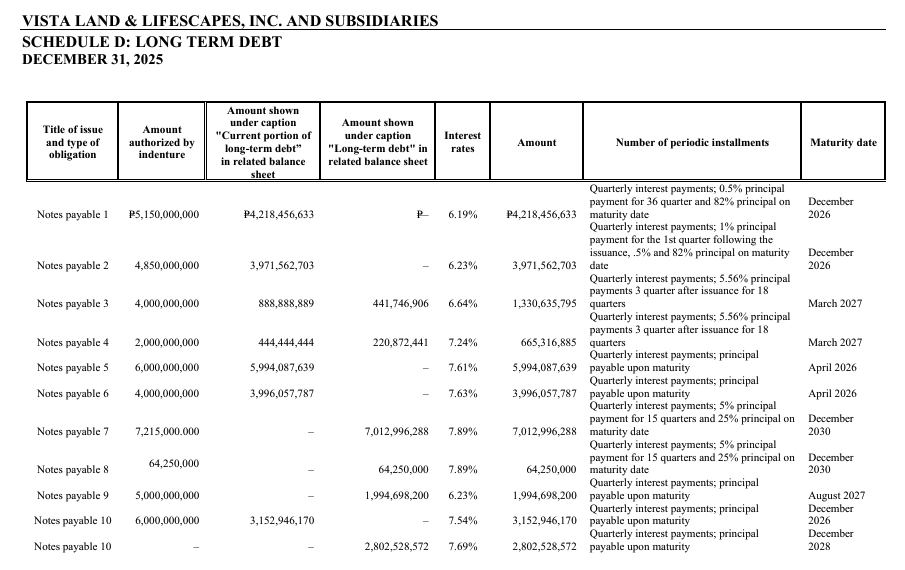
DEBT. Tables showing the sizable loans that Vista Land must repay in the coming years. Tables from Vista Land’s 2025 audited financial statements

The Villars’ debt pressure is well documented. Vista Land’s 2025 audited report alone identified:

  • Around P21.33 billion in notes and bonds scheduled to mature in 2026, based on balances at the end of 2025
  • $420 million* (P26.8 billion) in overseas notes maturing in July 2027
  • P2 billion in corporate notes being repaid in installments through March 2027
  • P2 billion in retail bonds due August 2027

Vista Land’s major shareholders themselves stepped in to finance the company, extending P22.49 billion in interest-bearing loans in 2025 that were used to repay maturing debt.

And that’s just what Vista Land’s (long-delayed) books tell us. Several other listed Villar companies have yet to release their overdue financial statements.

Who knows what other surprises could be hiding in there? – Rappler.com

Must Read

Mark Villar switches camps. Minutes later, family’s troubled firms make their move.


Mark Villar switches camps. Minutes later, family’s troubled firms make their move.

*$1 = P63.85 based on the October 29, 2026 rate of the Bankers Association of the Philippines

Similar Posts

  • | | | |

    NAB clarifies Rs500 million jurisdiction threshold

    ISLAMABAD: The National Accountability Bureau (NAB) has internally clarified that inflation-based adjustments to the value of liabilities cannot be used retrospectively to bring older, lower-value corruption cases under its jurisdiction. The clarification follows the enforcement of the National Accountability (Amendment) Act 2026 on March 5. NAB has issued internal guidance for prosecutors and investigators to ensure a uniform legal position on the revised Rs500 million threshold. Under the amended law, an offence falls within NAB’s jurisdiction when it involves corruption or misconduct involving at least Rs500 million. The law also links the financial threshold to annual inflation indicators issued by the Pakistan Bureau of Statistics, with the adjustment taking effect from July 1, 2026. However, NAB’s internal interpretation distinguishes between the statutory jurisdictional threshold and the inflation-adjusted value of liabilities. The Rs500 million figure remains the basic test for determining jurisdiction. Inflation adjustment is applied only after the actual liability involved in a case has been finally determined. The guidance identifies three situations based on when the alleged offence occurred. For offences committed before July 2022, the original amount involved will be assessed according to the year in which the offence took place. No inflation adjustment will be applied retrospectively. If the final liability is Rs500 million or more, NAB will retain jurisdiction. If it is below Rs500 million, the case will fall outside NAB’s jurisdiction and may be transferred to the ordinary courts. For offences committed after July 2022, the Rs500 million threshold will initially determine NAB’s jurisdiction. Once an inquiry or investigation establishes the final amount involved, the relevant inflation index for the year in which the case reaches its final stage will be applied if the original liability is at least Rs500 million. The final reference will therefore contain both the original liability and its inflation-adjusted value. If the original liability is below Rs500 million, no inflation adjustment will be made and NAB’s jurisdiction will cease. The third category concerns continuing offences that began before July 2022 but continued after that date. Such cases will be treated in the same manner as offences committed after July 2022. The guidance further states that once the original liability has been finally established and the inflation-adjusted amount has been calculated, the resulting figure will be considered final. It will not be repeatedly revised on the basis of inflation increases in subsequent years. According to the internal legal position, linking the financial threshold to inflation was intended to keep the threshold realistic and relevant over time and prevent inflation from reducing its practical value. NAB has also clarified that the amendment was not intended to retrospectively expand the bureau’s jurisdiction or disadvantage accused persons. The 2026 amendments made another significant change by expanding provisions concerning the transfer of cases falling outside NAB’s jurisdiction. The relevant provision now extends to pending appeals as well, whereas the earlier framework was primarily limited to inquiries, investigations and trials.

  • | | |

    Aurangzeb, Baker discuss stronger Pak-US economic …

    Federal Minister for Finance Muhammad Aurangzeb met US Chargé d’Affaires Natalie Baker on Monday to discuss ways to strengthen Pakistan-US economic relations, trade and investment cooperation. According to the Finance Ministry, Aurangzeb briefed the US diplomat on his recent visit to Washington and meetings with senior American officials, including the US Treasury secretary. He also shared details of discussions with officials from the International Monetary Fund (IMF), US International Development Finance Corporation (DFC) and US Export-Import Bank. The meeting focused on increasing US investment and financing for commercially viable projects in Pakistan. Both sides also discussed improving Pakistan’s access to US markets and expanding Pakistani exports. The two sides agreed to advance a framework aimed at increasing bilateral trade and investment. They also discussed Pakistan’s participation in international capital markets and efforts to diversify the country’s sources of financing. According to the ministry, discussions also covered measures to strengthen foreign exchange reserves and improve Pakistan’s credit profile. Opportunities for greater investment by US financial institutions in Pakistan were reviewed. Cooperation in key sectors, including ports, logistics, energy and telecommunications, also came under discussion. The two sides explored potential collaboration in digital technology and artificial intelligence. Aurangzeb said significant progress had been made in negotiations on a bilateral trade framework between Pakistan and the United States. He said the government was working to create a more favourable environment for private-sector investment. The finance minister welcomed the interest of US companies and investors in Pakistan. He said the government was continuing reforms aimed at improving the business and investment climate. Aurangzeb also briefed the US chargé d’affaires on Pakistan’s new system for daily adjustments in petroleum product prices. He explained that the mechanism was designed to align domestic prices more closely with developments in the international market. He said the government’s priorities included maintaining fiscal discipline, strengthening foreign exchange reserves and increasing exports. He added that reforms were underway to improve economic stability and attract investment. Natalie Baker appreciated Pakistan’s efforts to manage its economic situation during a period of regional tensions. She also praised the country for maintaining economic and financial stability despite rising energy prices.

  • |

    Gold prices jump Rs3,000 per tola in Pakistan

    Gold prices continued their upward trend in Pakistan on Friday, with the price of the precious metal increasing by Rs3,000 per tola in line with gains in the international market. According to the All Pakistan Gems and Jewellers Association (APGJA), the latest increase pushed the price of one tola of gold to Rs430,436, marking another sharp rise in the local bullion market. The increase comes amid continued strength in global gold prices and growing demand for safe-haven assets. The association also reported an increase in the price of 10 grams of gold. Following a rise of Rs2,572, the price of 10 grams reached Rs369,029. Bullion dealers said local gold prices generally move in line with international market trends and are also influenced by fluctuations in the value of the Pakistani rupee against the US dollar. Any increase in global prices is usually reflected in domestic rates. In the international market, gold prices also recorded a significant gain. The price of the precious metal rose by $30 per ounce, taking it to $4,080 per ounce. The global increase provided further support to rising prices in Pakistan. Gold is widely regarded as a safe investment during periods of economic uncertainty and market volatility. As international prices continue to strengthen, local buyers and jewellers are closely monitoring market movements for further changes in bullion rates. Market analysts believe domestic gold prices will continue to follow international trends, with future movements depending on global economic conditions, investor demand and currency fluctuations. Buyers are expected to remain cautious as higher prices increase the cost of jewellery and investment purchases

  • |

    Pakistan, Japan agree to expand development cooperation

    Pakistan and Japan have reaffirmed their commitment to strengthening long-standing development cooperation, with both sides agreeing to expand collaboration in economic reforms, mineral development, technical training, and human resource development during a high-level meeting in Islamabad. The understanding was reached during a meeting between Prime Minister Shehbaz Sharif and a nine-member delegation led by Japan International Cooperation Agency (JICA) President Dr. Tanaka Akihiko. Welcoming the delegation, Prime Minister Shehbaz Sharif described the seven-decade partnership between Pakistan and Japan as a cornerstone of bilateral relations, expressing confidence that the JICA president’s visit would inject fresh momentum into cooperation between the two countries. The prime minister highlighted the government’s ongoing economic reform agenda, stating that Pakistan had successfully navigated a challenging economic period through coordinated efforts and was now focused on achieving sustainable and inclusive economic growth. He said the government’s reform programme had produced encouraging results, noting that national revenues had doubled over the past three years. According to the prime minister, these improvements were creating greater fiscal space for investment in development priorities and public welfare. Shehbaz Sharif emphasized that equipping young people with modern skills and technical education remains one of the government’s foremost priorities. He said the administration is also committed to creating quality employment opportunities and promoting the economic empowerment of women as part of its broader development strategy. During the meeting, the prime minister welcomed JICA’s technical assistance in Pakistan’s minerals sector, describing the cooperation as timely given the country’s vast untapped mineral resources. He also appreciated JICA’s collaboration with the Small and Medium Industrial Development Authority (SMIDA), saying such partnerships would help strengthen industrial capacity, improve productivity, and boost Pakistan’s exports. The discussions also covered ways to broaden bilateral cooperation in areas including infrastructure development, capacity building, vocational training, and investment promotion. Both sides acknowledged the importance of expanding technical collaboration to support Pakistan’s long-term economic transformation. JICA President Dr. Tanaka Akihiko thanked Prime Minister Shehbaz Sharif for his warm welcome and appreciation, reaffirming Japan’s commitment to supporting Pakistan’s development journey. He noted that JICA and Pakistan share a long-standing partnership built on mutual trust and cooperation, adding that the agency remains ready to further expand its engagement across multiple sectors, including economic development, human resource development, and technical cooperation.

  • | | |

    PSX ends week on negative note, KSE-100 loses near…

    The Pakistan Stock Exchange (PSX) witnessed a bearish trend during the outgoing business week, with the benchmark KSE-100 Index losing 2,938 points as investor sentiment remained under pressure. The KSE-100 Index closed the week at 177,166 points, compared with its previous level. During the week, the index fluctuated within a range of 5,048 points, reaching a high of 181,158 points and falling to a low of 176,110 points. Trading activity remained substantial throughout the week, with around 4.22 billion shares changing hands at a total value of approximately Rs205 billion. Meanwhile, the market’s overall capitalization declined by Rs247 billion during the week, settling at around Rs19.88 trillion. The weekly performance reflects continued volatility in the stock market as investors closely monitor domestic economic developments and regional geopolitical conditions. Earlier, Pakistan’s benchmark stock index opened on a positive note on Friday, with strong buying interest across major sectors pushing the KSE-100 Index more than 800 points higher in the early trading session. At around 9:19am, the KSE-100 Index was trading at 177,399.75 points, recording a gain of 807.99 points, or 0.46%, compared with the previous close. The early-session rally reflected renewed investor interest in several key sectors of the market. Automobile assemblers, cement companies, commercial banks, fertiliser manufacturers, oil marketing companies (OMCs) and refineries remained among the prominent areas attracting buying activity. Several index-heavy stocks also traded in positive territory, providing support to the benchmark. Shares of Attock Refinery Limited (ARL), Mari Energies Limited (MARI), Fauji Fertilizer Company (FFC), Habib Bank Limited (HBL), Meezan Bank Limited (MEBL), National Bank of Pakistan (NBP) and United Bank Limited (UBL) were among the notable gainers during the opening phase. The positive start comes a day after the Pakistan Stock Exchange witnessed a volatile trading session amid concerns over geopolitical developments and elevated international oil prices. On Thursday, the KSE-100 Index lost 254.59 points, or 0.14%, to settle at 176,591.77 points. Selling pressure in several heavyweight stocks outweighed selective buying and kept the market in negative territory by the close. Investors are now closely monitoring developments in global financial markets, particularly movements in bond yields, oil prices and international geopolitical conditions, which could influence capital flows and market sentiment. Global markets remain under pressure The positive opening at the PSX came against a mixed backdrop in Asian markets, where several major stock indices remained on track for weekly declines. Investor sentiment globally continued to be affected by rising government bond yields and uncertainty surrounding inflation and fiscal conditions. A diplomatic stalemate in the Gulf region also contributed to a rise in oil prices, with crude prices reaching their highest level in about a month. Higher oil prices have renewed concerns over inflation, particularly for economies that rely heavily on energy imports. For Pakistan, movements in international crude prices remain particularly important because they can affect the country’s import bill, exchange-rate pressures and domestic inflation expectations. In the United States, Treasury yields resumed their upward movement after a brief respite following an unexpected intervention by the US Treasury on Wednesday. US Treasury Secretary Scott Bessent has indicated that the government could potentially expand its purchases of US Treasuries. He has also raised the possibility of fiscal consolidation as authorities seek to address concerns surrounding the country’s growing budget deficit. However, market participants remain cautious about the prospects of significant fiscal adjustment. Analysts have questioned whether sufficient expenditure reductions can be achieved to meaningfully narrow a budget deficit exceeding 6% of US gross domestic product. The rising cost of servicing government debt is another concern. Interest payments alone are estimated to have reached around $1.2 trillion during the year, highlighting the pressure created by elevated borrowing costs. Higher yields pose challenge for equities The continued increase in bond yields has broader implications for international equity markets. Higher yields can increase borrowing costs for governments and businesses while making fixed-income investments relatively more attractive. The impact is particularly significant for technology companies that are undertaking substantial borrowing to finance investments in artificial intelligence infrastructure and other capital-intensive projects. At the same time, higher interest rates increase the discount rate applied to future corporate earnings, potentially putting pressure on equity valuations. Asian markets reflected some of these concerns on Friday. Japan’s Nikkei index declined around 0.8%, taking its losses for the week to approximately 4.4%. South Korean and Taiwanese stocks managed modest gains during the session but remained lower on a weekly basis. Meanwhile, MSCI’s broadest index of Asia-Pacific shares excluding Japan advanced around 0.5%, indicating some selective risk appetite despite continued uncertainty in global markets.

  • | | |

    Daily petrol prices trigger Senate debate over tra…

    Islamabad: Pakistan’s new daily petroleum pricing system came under serious discussion in the Senate as lawmakers questioned whether the mechanism is providing relief to consumers or creating new challenges for the public and fuel dealers. The Senate Standing Committee on Petroleum reviewed the daily petrol price determination system and demanded clarity over why the government replaced the previous fortnightly price revision system with daily changes. The committee questioned the reasons behind the new policy and asked whether frequent price adjustments were helping ordinary citizens or increasing uncertainty in the fuel market. Federal Minister for Petroleum informed the committee that the government had removed political influence from the petroleum pricing process by giving the responsibility of setting prices to the Oil and Gas Regulatory Authority (OGRA), an independent regulator. He said the new system was introduced to make petroleum price decisions more transparent and based on market conditions. OGRA Chairman informed the committee that petrol prices are calculated through a seven day average of international Platts benchmark prices. He explained that instead of directly passing sudden changes in international oil markets to consumers, the seven day average spreads the impact over time. According to OGRA, the system helps reduce sudden price shocks, especially during international tensions and market uncertainty. Officials said the daily pricing mechanism also aims to discourage people from creating artificial shortages or making unfair profits through speculation. However, senators raised concerns about the effect of frequent price changes on citizens and businesses. The committee expressed concern over the high tax burden on petroleum products and questioned how increasing fuel costs affect the daily lives of ordinary people. Representatives of the Petroleum Dealers Association informed the committee that frequent price revisions were creating operational difficulties for fuel dealers. They said continuous price changes make business planning more difficult and require better coordination between authorities and dealers. The committee directed OGRA to consult all stakeholders, including petroleum dealers, and prepare practical recommendations to address their concerns. Members also stressed the need for greater use of technology in the petroleum supply chain to prevent fuel smuggling, adulteration and illegal storage. The committee said a stronger digital monitoring system could improve transparency and ensure consumers receive better quality fuel. Senator Umer Farooq chaired the meeting of the Senate Standing Committee on Petroleum, where members reviewed the new pricing system and related petroleum sector issues. The committee emphasized that petroleum pricing directly affects every citizen because fuel costs influence transportation, business expenses and prices of daily goods. Members said the government and regulators must ensure that any pricing system protects consumers while maintaining stability in the petroleum market. The committee directed OGRA to continue reviewing the mechanism and ensure that the interests of consumers remain the top priority.

Leave a Reply

Your email address will not be published. Required fields are marked *