august total solar
|

Why August 12 total solar eclipse is so special?

The last total solar eclipse occurred two years ago and once again millions of people will have the opportunity to witness this rare celestial event.

This year’s eclipse is particularly special because some observers will see the total solar eclipse at sunset making it an exceptionally rare and breathtaking sight.

According to NASA, the total solar eclipse will occur on August 12 but only a limited number of countries will experience totality. People in Greenland, Iceland, northern Spain and a small part of Portugal will be able to witness the total eclipse.

In Spain, the eclipse will coincide with sunset creating a spectacular view that is expected to captivate skywatchers. A partial solar eclipse will also be visible across many other parts of Europe and Africa including most European countries and several regions of North Africa.

Russia will enjoy another rare phenomenon as a partial eclipse will be visible at both sunrise and sunset. On the remote Taymyr Peninsula, the partial eclipse will begin at sunrise while in another part of the country it will be seen at sunset.

Solar eclipses occurring at sunset are extremely rare which is one of the reasons why this year’s event is considered so unique.

According to Pakistan Standard Time (PST), the partial solar eclipse will begin at 10:34 PM, the total eclipse will start at 12:12 AM and the event will conclude at 2:58 AM.
Similar Posts

  • | | | |

    Pakistan, Saudi Arabia and Türkiye sign Makkah jo…

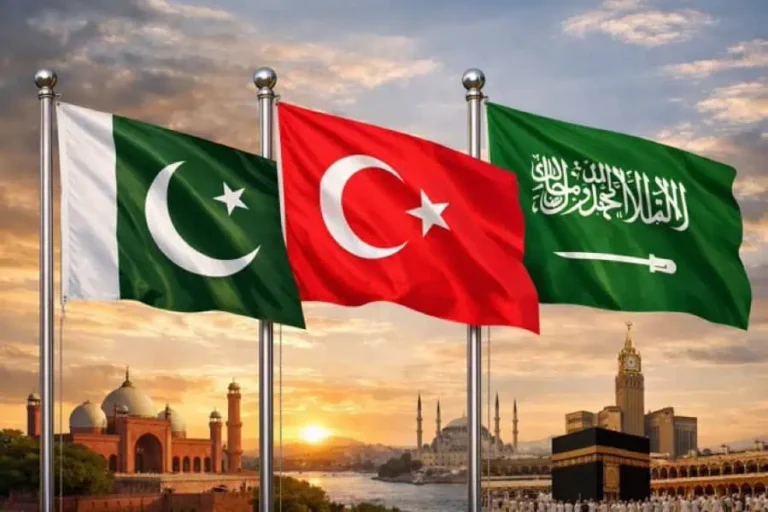
    MAKKAH: Pakistan, Saudi Arabia and Türkiye have signed the Makkah Joint Defence Agreement, pledging to strengthen collective security and defence cooperation among the three countries. The agreement was signed on Friday during a high-level summit at Al-Safa Palace in Makkah, where Saudi Crown Prince and Prime Minister Mohammed bin Salman received Pakistani Prime Minister Shehbaz Sharif and Turkish President Recep Tayyip Erdogan. According to the agreement, the three countries reaffirmed their commitment to strengthening collective security and promoting peace, stability and security in the region and beyond. The agreement is based on the longstanding relations and shared strategic interests of Pakistan, Saudi Arabia and Türkiye. It also highlights their continued defence cooperation and commitment to closer coordination on security matters. Any attack to be treated as an attack on all three A key provision of the agreement states that an armed attack against any one of the three countries will be regarded as an attack against all three. The pact is intended to enhance collective deterrence against acts of aggression and expand cooperation across various areas of defence. The agreement also seeks to strengthen military and security coordination among the three states and build a framework for closer cooperation in the face of regional security challenges. The summit brought together the leaders at a time of heightened tensions and instability across the Middle East. Recent reporting had indicated that the three countries were preparing to deepen defence coordination through a joint pact. Prime Minister Shehbaz Sharif was accompanied by Deputy Prime Minister and Foreign Minister Ishaq Dar, Chief of Army Staff and Chief of Defence Forces Field Marshal Syed Asim Munir, and Defence Minister Khawaja Asif. The leaders also reviewed bilateral and regional matters of mutual interest and discussed ways to further strengthen cooperation. The Makkah agreement marks a significant development in defence ties among Pakistan, Saudi Arabia and Türkiye, establishing a stronger trilateral framework for collective security and defence cooperation.

  • |

    British funeral director sentenced to 20 years in prison for fraud and desecration of remains

    Former funeral director Robert Bush, 48, has been jailed for 20 years at Hull Crown Court after pleading guilty to 67 criminal charges. The charges include preventing a lawful and decent burial, fraud by false representation, fraudulent trading, and theft, spanning a period of nearly 12 years at Legacy Independent Funeral Directors in Hull, East Yorkshire. The police investigation, launched in March 2024 following a report from a casual worker, uncovered 35 decomposing bodies left uncovered and un-cremated at the business’s Hessle Road premises. Investigators revealed that Bush had repeatedly provided grieving relatives with ashes belonging to strangers, including delivering young adult remains to the parents of a stillborn baby whose body was discovered stored in a paper bag on site. Bush also stole thousands of pounds in charitable donations collected from mourners at memorial services. Presiding Judge Nicholas Hilliard described Bush’s actions as “heartless” and motivated by greed, noting that his crimes caused pain and anguish on an incomprehensible scale. Alongside the 20-year custodial sentence, Bush has been banned from acting as a company director for 14 years. The severe failure has prompted renewed demands across the United Kingdom for stricter statutory regulation of the funeral industry.

  • Productivity and Time Management

    By: Asma Qayyum With the rapid pace of modern life, productivity and time management have become vital skills for students, professionals, and individuals alike. With increasing responsibilities and constant distractions, managing time effectively is the key to achieving success. Productivity refers to the ability to complete tasks effectively by making the best use of time, energy, and resources. On the other hand, time management is the process of planning and organizing how time is spent on different activities to accomplish goals efficiently. The greatest benefit of effective time management is increased efficiency. People who plan their day and prioritize their most important tasks are more likely to meet deadlines, stay productive, and produce higher-quality work. It also helps reduce stress by preventing last-minute pressure and allowing people to complete their tasks in a calm and organized manner. For example, students who follow a regular study schedule usually perform better in examinations than those who rely on last-minute preparation. Despite these benefits, several factors reduce productivity, including procrastination, excessive use of social media, poor planning, and a lack of clear goals. These habits waste precious time and make it difficult to focus on essential responsibilities. However, with the right approach, these challenges can be overcome through self-discipline and proper planning. There are several ways to improve productivity, such as creating a daily to-do list, avoiding unnecessary distractions, setting realistic goals, completing the most important tasks first, taking short breaks, following a regular routine, and managing time effectively. Research highlights the importance of effective time management. According to the American Psychological Association (APA), planning tasks and managing time can help reduce stress and improve overall well-being. Similarly, educational research by Pan et al. (2011) found that strong time management skills are directly associated with higher study engagement and greater achievement of academic goals. In conclusion, productivity and time management are not just useful skills but essential habits for success. By managing time wisely and staying focused on priorities, individuals can accomplish more, reduce stress, and create opportunities for personal and professional growth. Every second is valuable, and learning to manage time effectively is one of the best investments anyone can make in their future.

  • |

    Indonesia hit by powerful 7.7 earthquake, Tsunami …

    A powerful 7.7-magnitude earthquake struck off Indonesia’s Flores region early Saturday, August 15, 2026, sending strong tremors across parts of eastern Indonesia and prompting authorities to issue a tsunami warning for vulnerable coastal areas. The earthquake struck at around 5:58am local time, with the epicentre near Nagekeo in East Nusa Tenggara. The relatively shallow quake was followed by several aftershocks, intensifying fears among residents living near the coast. Indonesia’s Meteorology, Climatology and Geophysics Agency (BMKG) issued a tsunami warning shortly after the earthquake and urged people in exposed coastal areas to move to higher ground as a precaution. Minor tsunami waves were subsequently recorded in some locations. The powerful shaking caused damage to buildings and other infrastructure in parts of East Nusa Tenggara. Residents rushed outdoors as buildings shook, while emergency teams began assessing the extent of the destruction. At least several people were reported killed or injured, although casualty figures remained subject to change as rescue teams reached affected areas. In some locations, hospitals moved patients outdoors amid concerns over building safety. The earthquake also triggered evacuations, with thousands of residents moving away from coastal areas after the tsunami alert. Authorities continued monitoring sea levels and aftershocks as emergency operations got underway. The tsunami warning was later lifted after officials found no continuing threat of major waves. Australia’s tsunami warning authorities also said the earthquake posed no tsunami threat to mainland Australia, its islands or territories. Indonesia lies along the seismically active Pacific Ring of Fire, making the country particularly vulnerable to powerful earthquakes and volcanic activity. Authorities have urged residents in affected areas to remain alert, follow official instructions and avoid damaged structures while inspections and rescue operations continue.

  • | | |

    Iran sets tough conditions for Strait of Hormuz re…

    Iran has warned that the strategically vital Strait of Hormuz will remain closed until the United States meets a series of conditions under a June memorandum of understanding, raising fresh concerns about the future of a conflict that has already disrupted global energy markets. Iranian Parliament Speaker Mohammad Bagher Ghalibaf said on Tuesday that Tehran would not reopen the waterway until what he described as the full terms of the agreement had been implemented. According to Iranian state media, Ghalibaf said the blockade must first be lifted, Iran’s frozen assets released, oil sanctions removed and military threats and operations on all fronts brought to an end. He also insisted that other provisions of the memorandum must be fully implemented. “Iran is prepared to impose a heavier defeat on the enemy than before,” Ghalibaf said, warning that Tehran’s response would depend on the actions and aggression of its opponents. The statement came as diplomatic efforts to secure a permanent end to the Iran-US conflict appeared increasingly fragile. Iran Claims Victory in War and Diplomacy Iranian Foreign Minister Abbas Araghchi separately declared that Tehran had won both the military confrontation and the diplomatic battle. Speaking at an event, Araghchi said Iran had resisted sustained military pressure before entering negotiations. He claimed that those who initially demanded Iran’s unconditional surrender later sought talks with Tehran. “We fought with strength, and we negotiated with strength,” Araghchi said, according to Iranian media. Araghchi also accused Israel of undermining efforts to implement the June memorandum, saying it had worked to prevent the agreement from being reached and subsequently obstructed its implementation. His comments followed US President Donald Trump’s call for Iran to surrender and “raise the white flag”, further highlighting the sharp divide between Washington and Tehran. Hormuz Becomes Central Dispute The Strait of Hormuz has emerged as one of the most important points of disagreement between the two sides. The narrow waterway links the Persian Gulf with the Gulf of Oman and is a crucial route for global oil and liquefied natural gas shipments. Shipping activity has already fallen dramatically during the conflict. Reuters reported that only a handful of commodity vessels crossed the strait over the weekend, compared with more than 130 daily ship transits before the war began. Iran says provisions of the June memorandum give it authority to manage parts of the waterway, while Washington rejects that interpretation. The disagreement has contributed to renewed tensions after an earlier ceasefire failed to produce a lasting settlement. Vessel Hit by Unknown Projectile The latest tensions were accompanied by another maritime incident. The UK Maritime Trade Operations centre said a vessel travelling outbound through the Strait of Hormuz was struck by an unknown projectile. The impact damaged the ship’s engine room and caused a crew casualty. The remaining crew members were assisted by the Omani Coast Guard, while authorities began investigating the incident. No environmental impact was reported. UKMTO urged vessels operating in the area to exercise caution and report suspicious activity. Back-Channel Diplomacy Continues Despite the increasingly hostile rhetoric, reports indicate that Washington and Tehran have continued exploring indirect channels. Media reports said the Trump administration had established a back channel involving figures connected to Iran’s Islamic Revolutionary Guard Corps. The reported effort reflected US concerns over whether Iranian negotiators had sufficient authority to deliver an agreement acceptable to the country’s powerful security establishment. US special envoy Jared Kushner also indicated that discussions between Washington and different parts of the Iranian government were more extensive than publicly acknowledged. The developments suggest that diplomacy has not completely collapsed, even as official statements from both sides remain confrontational. Iran Faces Economic Pressure Iran’s leaders also face significant economic challenges. The conflict has added pressure to an economy already struggling with inflation, sanctions, currency weakness, energy shortages and structural problems. Disrupted trade, damaged infrastructure and lost production have increased the financial burden of the war, while prolonged restrictions on shipping through Hormuz threaten Iran’s ability to generate export revenue. Global markets have also felt the impact. Brent crude rose sharply during the conflict, reaching a peak of $126 a barrel before later easing. The prolonged disruption has raised concerns over fuel prices and inflation in countries dependent on Gulf energy supplies. Ghalibaf Heads to Iraq Against this backdrop, Ghalibaf is expected to travel to Iraq for talks on regional developments and bilateral cooperation. His discussions are expected to cover security, border management, counterterrorism, economic cooperation and implementation of existing agreements between Tehran and Baghdad. The visit comes after a drone attack targeted the residence and private office of Iraqi Kurdish Regional Government Prime Minister Masrour Barzani. Iran denied involvement and condemned the incident. Araghchi said nothing justified the attack and warned against attempts to create divisions between Iran, Iraq and the Kurdish region. With the Strait of Hormuz still at the centre of the dispute, the coming days could prove crucial. Tehran’s insistence on sanctions relief, the release of frozen assets and an end to military threats leaves little room for compromise unless Washington and its allies are prepared to make substantial concessions. For now, the strategic waterway remains a powerful bargaining tool for Iran — and a major source of uncertainty for the global economy.

Leave a Reply

Your email address will not be published. Required fields are marked *