talking yourself may

Talking to yourself may boost brain power

Some habits may look strange to other people. Talking to yourself is one of them.  Many people think it shows poor concentration or a weak mind but research suggests that this habit can sometimes have positive effects.

Self talk can support your brain

Talking to yourself can help you organize your thoughts and understand your feelings.  It may also help improve memory focus, and confidence.

A 2012 study found that people who talked to themselves could identify objects in pictures more quickly.  This suggests that saying things out loud may sometimes help the brain focus on what it is looking for.

It may improve self control

Research has also found a possible link between self talk and better self control.  Talking through a problem can help people think before acting and make better decisions.

Self talk may also help people understand themselves better by giving them a chance to think about their feelings plans and problems.

Positive self talk matters

Not all self talk is helpful. Constantly criticizing yourself or using negative words can make you feel worse and may affect your confidence.

Positive and balanced self talk can be more useful. For example reminding yourself to stay calm focus on a task or keep trying can help you manage difficult situations.

So if you sometimes talk to yourself there is no need to feel embarrassed.  When kept positive and balanced this simple habit may help you focus organize your thoughts and understand yourself better.

Similar Posts

  • |

    How intentional attention can transform the ordinary

    The human mind often defaults to a posture of constant vigilance in the world dominated by endless news, digital noise, and social anxiety. We scan our environments for threat, hardship, and dysfunction. We maintain psychological defense mechanism sharpened by evolution and modern technology. The poet and educator Ross Gay demonstrated in his literary project, The Book of Delights that there exists a quiet, radical counter-practice. It’s the deliberate development of wonder on daily basis. It all began as a personal experiment on his forty-second birthday and turned into a meditation on how we inhabit time, space, and community. This educator wrote a short essay every single day for a year. He would capture a specific moment or observation that brought him joy. The resulting body of work reveals that gladness is something that simply happens to us even if it’s rare. When we think of joy or delight, we frequently imagine grand milestones. We suppose a long-awaited promotion, a dream vacation, or a monumental life event. Gay’s yearlong experiment turns this perspective upside down. His essayettes focus on the fleeting occurrences that populate everyday existence. For instance, the taste of fresh fruit picked directly from a vine. It can be warmth of two strangers sharing a brief smile on a crowded bus. We can’t neglect the simple relief of taking off uncomfortable shoes after a long walk. Gay discovered a psychological shift that he likened to developing a delight radar. When you know you must document joy before the day ends, your mind begins to actively search for it throughout your waking hours. You stop treating small encounters as background noise and start recognizing them as vital happenings. Attention itself becomes an act of appreciation. Crucially, this practice does not require ignoring life’s harsh realities. True gladness is not toxic positivity or the denial of suffering. Gay’s reflections frequently touch upon systemic injustice, racial prejudice, grief, aging, and personal loss. What makes his work so resonant is its insistence that delight and sorrow exist side by side. Noticing beauty amidst difficulty is not an act of escapism; it is a form of emotional resilience that sustains us through hard times. Another significant insight from Gay’s experiment is that delight is inherently contagious. Unlike physical resources that diminish when shared, human gladness expands when communicated. Gay illustrates how pointing out a pleasant detail to someone else creates a sweet bond of togetherness whether it’s about a casual interaction with local vendor or an unexpected moment of humor with neighbor. In a world that frequently feels fragmented and polarized, taking note of small wonders acts as a bridge. It reminds us of our shared vulnerability and our common capacity for appreciation. When we point to pastel sunset, a blooming flower breaking through sidewalk concrete or a delicious cup of coffee, we are essentially saying: Look, isn’t it incredible that we get to experience this together? You do not need to publish a book of essays to incorporate this mindset into your daily routine. Small, consistent habits can rewire how you perceive your day-to-day environment. You need two minutes before bed to write down one specific, physical thing that brought you comfort or pleasure during the day. Specificity matters instead of writing good lunch, detail the aroma of the spices or the crunch of fresh bread. Shift your focus away from digital screens periodically to notice physical textures, sounds, and scents around you. Acknowledge the feel of sunlight on your skin or the rhythm of rain against a windowpane. Tell someone when they make your day slightly better. A genuine compliment or a warm word of thanks multiplies the delight for both giver and receiver. Allow yourself to pause for ten seconds when something pleasant happens. Savoring a moment briefly allows the brain to encode positive experiences more deeply. Ultimately, practicing willful gladness is a choice to honor the gift of being alive.  

  • |

    Kashmir’s nightingale Habba Khatoon

    Habba Khatoon stands as Kashmir’s Nightingale and Zoon: the Moon of Kashmir. Living in the 16th century, she transformed personal grief, marital heartbreak, and political exile into the foundational canon of Kashmiri romantic poetry. She was born to a peasant family in Chandhara village (Pampore), famous for its saffron fields. Unlike most rural girls of her era, her father sent her to a local maktab where she learned Persian and Arabic, nurturing her early literary talent. She got married to a peasant named Aziz Rathar. Unappreciative of her poetic disposition and intelligence, her husband and mother-in-law ill-treated her. She began singing her inner pain while working in the saffron fields and fetching water. Legend holds that while hunting near Pampore, Prince (later Sultan) Yousuf Shah Chak heard her singing under a plane tree. He arranged her divorce and married her as he was mesmerized by her voice and beauty. This marriage elevated her to Queen of Kashmir as Habba Khatoon. Emperor Akbar summoned Sultan Yousuf Shah to Delhi under the pretense of talks, arrested him, and exiled him to Bihar. Kashmir fell to Mughal rule, breaking Habba Khatoon’s world. She shed her courtly garments, donned the robes of an ascetic, and wandered the valley singing lamentations for her lost king. In short, she refused royal comfort. She spent her final years near Gurez and Athwajan, where her tomb rests today. Before Habba Khatoon, Kashmiri verse was dominated by devotional mysticism: Vaakhs and Shrukhs. She revolutionized Koshur literature by introducing the Lol. Lol is a short, melic lyric of intense personal feeling, love, longing, and domestic intimacy. It’s particularly designed to be sung rather than recited. One of her most iconic pieces, sung to this day across the valley: Mey haa karchey kitt kitaye, Mey kar tayiaar lole-vun… Chey kyaah gazi chaani roopeye, Volo haa maalyene dhoopeye! I have prepared myself in every way, I have composed my heart into a song of longing… What does it cost your beauty to look upon me? Come, my love, let us gather wild mountain herbs together! In the following verses, she uses Kashmir’s fleeting spring as an allegory for human beauty and time: Gulaan goy rang, pholan goy bahar, Mey valai poshan hyund hahaar… Yuthus chhumyene chaani dhaar, Volo maayi chaane pyarey! The flowers have faded, spring has taken its leave, My youth is wilting like a blossom in the heat… My eyes remain fixed on the path where you disappeared Come back, my beloved, for the sake of love!   After emperor Akbar exiled her husband to Bihar, she wrote this verse that captures geopolitical heartbreak reduced to raw human loss: Cchey saazey vaaye, bo saazey vaaye, Kati chhak chey, bo kati chhas… Diluk zaar vanay kith-kith bo, Jeel-e-Jhelum geyi aaba-haar! You play your tune far away, while I play mine in solitude, Where are you trapped, and where am I left to wander? How shall I tell you the agony of my heart? Even the waters of the Jhelum weep and overflow their banks for us. Her poetry is more than a story of personal transformation. It is the emotional arc of Kashmir itself. By introducing the Lol, she pulled Kashmiri verse down from abstract, detached mysticism into the intimate, beating heart of human experience. She gave language to the quiet endurance of ordinary women, the agony of sudden separation, and the unyielding beauty of a homeland caught in the tides of history.  

  • |

    Why August 12 total solar eclipse is so special?

    The last total solar eclipse occurred two years ago and once again millions of people will have the opportunity to witness this rare celestial event. This year’s eclipse is particularly special because some observers will see the total solar eclipse at sunset making it an exceptionally rare and breathtaking sight. According to NASA, the total solar eclipse will occur on August 12 but only a limited number of countries will experience totality. People in Greenland, Iceland, northern Spain and a small part of Portugal will be able to witness the total eclipse. In Spain, the eclipse will coincide with sunset creating a spectacular view that is expected to captivate skywatchers. A partial solar eclipse will also be visible across many other parts of Europe and Africa including most European countries and several regions of North Africa. Russia will enjoy another rare phenomenon as a partial eclipse will be visible at both sunrise and sunset. On the remote Taymyr Peninsula, the partial eclipse will begin at sunrise while in another part of the country it will be seen at sunset. Solar eclipses occurring at sunset are extremely rare which is one of the reasons why this year’s event is considered so unique. According to Pakistan Standard Time (PST), the partial solar eclipse will begin at 10:34 PM, the total eclipse will start at 12:12 AM and the event will conclude at 2:58 AM.

  • | | |

    The silence of the state

    Al Jazeera’s digital domain was restricted in Pakistan following its critical coverage of regional unrest and local election turmoil. Pakistan had become the second country after Israel to ban the Qatari broadcaster. While the statement makes for a soundbite, it oversimplifies both history and the mechanics of state censorship. In reality, the history of sovereign states attempting to mute inconvenient journalism is long, systemic, and filled with precedent. The Reality Behind the Headlines The recent digital restrictions in Pakistan emerged after the network broadcast extensive ground coverage of civil protests, Internet shutdowns, and election-related violence in Pakistan-administered Kashmir. State authorities responded by accusing the international news organization of yellow journalism and selective reporting. Shortly after, users across the country reported that the network’s website had become inaccessible. Repeated bans on Al Jazeera However, this action makes Pakistan the first nation to follow Israel’s 2024 ban overlooks press suppression. Over the past two decades, Al Jazeera has faced repeated office closures, revocations and total broadcast bans across numerous jurisdictions. Egypt (2013): Following political upheaval, the government shut down the network’s local operations and detained several of its journalists under allegations of threat to national stability. The Gulf Blockade (2017): During a severe diplomatic rift, Saudi Arabia, the United Arab Emirates, Bahrain, and Jordan blocked the channel’s signals and shuttered its regional bureaus. Israel (2024): Emergency legislation empowered authorities to halt local broadcasts, raid offices, and seize transmission equipment over national security claims. Far from being a rare sequel, the administrative impulse to silence an uncomfortable mirror is an old story retold. The Architecture of Banishment In literary traditions, the suppression of speech is rarely about the words themselves; it is about who holds the authority to define reality. George Orwell  observed in 1984 that the primary goal of totalitarian control is to limit the perimeter of thought by controlling the historical record. When a state apparatus brands unfavorable reporting as inherently fraudulent or subversive, it engages in an act of narrative containment. The label of yellow journalism becomes a rhetorical wall. This label shield the public from realities that disrupt official consensus. This dynamic reflects the bureaucratic absurdity depicted in Franz Kafka’s The Castle, where an elusive authority governs from above while remaining immune to direct questioning. In Kafka’s vision, the citizen is caught in a maze of unwritten rules and opaque decrees, where seeking transparency is treated as an act of insubordination. When digital portals are quietly restricted without formal public legislation or explicit judicial oversight, the state operates within a similarly Kafkaesque realm. The silence itself becomes an instrument of governance. The Illusion of Total Control There is a profound irony in modern media suppression. In classical literature, exile was absolute. A banished figure like Ovid was removed physically from the city center, their voice fading at the empire’s edges. Today, however, censorship in a hyper-connected world is an exercise in futility. Blocking a website or pulling a broadcast signal rarely extinguishes the narrative. Instead, it often draws greater international scrutiny to the very events the state wished to obscure. A phenomenon akin to the Streisand effect.   When governments resort to digital blockades, they reveal a fundamental fragility. True political stability rests on the capacity to withstand criticism.  To edit reality is like trying to stop the tide by breaking the hourglass. The water continues to rise, and the story, inevitably, finds another way to be told.

  • |

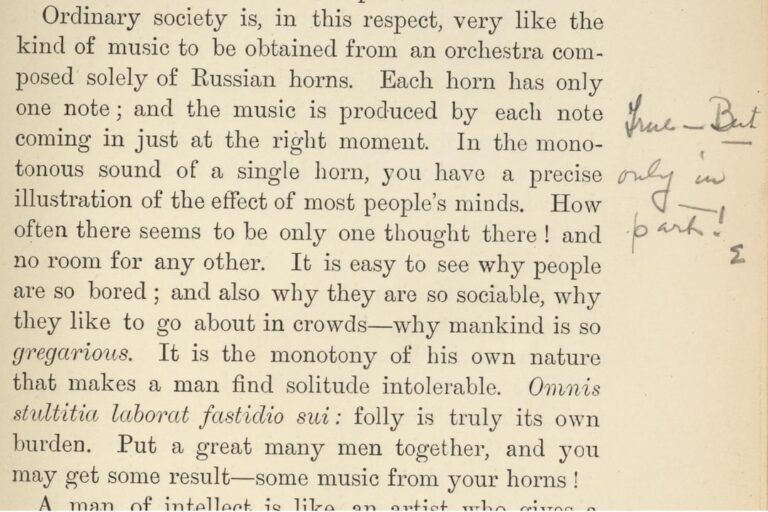
    Why marginalia is devised for conversation

    For centuries, books were treated as sacred, untouchable artifacts. Readers were taught to open a spine with reverence, turn pages by the edges, and never, under any circumstance, mark the paper. But in the modern reading culture, a quiet revolution has taken root: marginalia is no longer viewed as defacement. Today, it is recognized as a vital form of active intellectual engagement. Marking up a book transforms reading from a passive act of consumption into an active. Reading is a two-way dialogue between the reader and the writer. When you read with a pencil, pen, or sticky tab in hand, your relationship with the text fundamentally shifts. You cease to be a distant spectator observing someone else’s thoughts. In other words, you become a collaborator. Underlining a sentence, drawing an exclamation point next to a surprising plot twist, or a counterargument in the margin forces your brain to process language at a deeper level. It requires you to articulate why a passage resonated or failed. Furthermore, annotated books serve as personal time capsules. When you reopen a novel you marked up five or ten years ago, it offers an unfiltered reflection into who you were at that exact moment in your life. You might find yourself cringing at an old marginal note. Then you agree passionately with a circled phrase, or realizing that a passage you completely ignored years ago now carries personal meaning. The book becomes a physical record not just of the author’s story, but of your own cognitive and emotional evolution. Edgar Allan Poe once wrote: ‘In getting my books, I have been always solicitous of an ample margin … for the facility it affords me of pencilling suggested thoughts, agreements and differences of opinion …’ Practically speaking, marginalia also sharpens critical thinking. Students, scholars, and casual readers alike find that tracking themes through custom color-coded tabs or brief summary notes at the end of chapters drastically improves retention and comprehension. It prevents the common phenomenon of eye-scanning where your eyes move across sentences while your mind wanders elsewhere. Annotation demands presence. Ultimately, scribbling in the margins strips away the artificial pedestal we often place books upon. It reminds us that literature is not meant to sit pristine and untouched on a display shelf. Literature is meant to be wrestled with, questioned, celebrated, and lived in. The next time you open a book that challenges or moves you, don’t hold back. Pick up a pen, claim the empty white space on the page, and join a conversation that has been taking place across centuries.  

  • | |

    The Sham Shaman

    In 1968, a graduate student in anthropology at the University of California, published a book that would reshape the publishing world. Titled The Teachings of Don Juan: A Yaqui Way of Knowledge. The book purported to be a faithful academic field report by Carlos Castaneda detailing his apprenticeship under an elderly Yaqui shaman named Don Juan Matus in the Mexican desert. Castaneda’s account became an overnight sensation as it blended desert mysticism, hallucinogenic plant rituals, and philosophical paradoxes. It sold millions of copies, earning him a doctorate from UCLA. This success made him a guru to icons like Bob Dylan, John Lennon, and Octavio Paz. A Life Built on Fabrications Long before he wrote about desert sorcery, Castaneda had mastered the art of reinventing himself. Born César Carlos Salvador Arana in Peru in 1925—the son of a humble watchmaker—he routinely rewrote his origin story. He claimed to have been born in Brazil, shaved years off his age, and concocted wild tales of fighting as a soldier in North Korea or working as a border spy. In reality, he fled Peru after fathering a child at thirteen, eventually making his way to Los Angeles in the 1950s. Ground-breaking Anthropological Discoveries. Yet beneath the celebrated field notes lay one of the most audacious literary fabrications in modern history. Don Juan Matus was not a real person. The desert apprenticeships never took place. Castaneda was not a devoted field researcher. He was a master illusionist who deceived prestigious academics and eager seekers alike. When Castaneda enrolled at UCLA, he found an academic environment eager for authentic indigenous wisdom and existential insight. Synthesizing disparate ideas into a singular narrative, he assembled Don Juan’s philosophical worldview by freely borrowing from European philosophy, Buddhist theology, ethnomethodology, and popular horror fiction. To his impressionable professors, the resulting texts appeared to be ground-breaking anthropological discoveries. Unraveling the Hoax While Castaneda’s books topped bestseller lists throughout the late 1960s and 1970s, critical cracks in his story soon began to widen into chasms. Skeptical researchers and anthropologists began scrutinizing the timeline and claims in his field notes. Archive Contradictions: UCLA library records revealed that on dates Castaneda claimed to be in the Sonoran desert learning shamanic secrets, he was actually signed into the university library reading room. Botanical and Cultural Errors: Experts on Yaqui culture noted that the spiritual concepts and language attributed to Don Juan bore almost no resemblance to authentic Yaqui traditions or language structures. Philosophical Echoes: Literary sleuths discovered that Don Juan’s most profound dialogues were near-verbatim adaptations of modern academic sociology and Western philosophical texts. Despite being systematically exposed by critics, Castaneda maintained his mystique. He avoided photo shoots, refused interviews, and cultivated an aura of secretive invulnerability. He also assured his devotees that any perceived discrepancies were simply part of a sorcerer’s duty to erase his personal history. The Guru’s Reclusive Cult and Legacy As public acclaim gave way to scholarly embarrassment, Castaneda retreated further into reclusiveness. In the 1990s, he launched a movement called Tensegrity. He promoted a series of physical movements he claimed were ancient Toltec magical passes. Critics quickly noted their striking resemblance to modern martial arts taught by a local Santa Monica instructor. Surrounding himself with a inner circle of devout disciples in Los Angeles, Castaneda governed his group with increasing paranoia until his death from cancer in 1998. Anthropology’s Ultimate Trickster Ultimately, Carlos Castaneda remains a complex figure in cultural history. His anthropological credentials were exposed as entirely fraudulent. His writings captured the yearning of an era desperate for spiritual transcendence beyond traditional structures. He stands as anthropology’s ultimate trickster. He’s a man who turned a fictional thesis into a million-dollar empire and proved that, given the right narrative, millions of people will gladly step through the looking glass.

Leave a Reply

Your email address will not be published. Required fields are marked *