
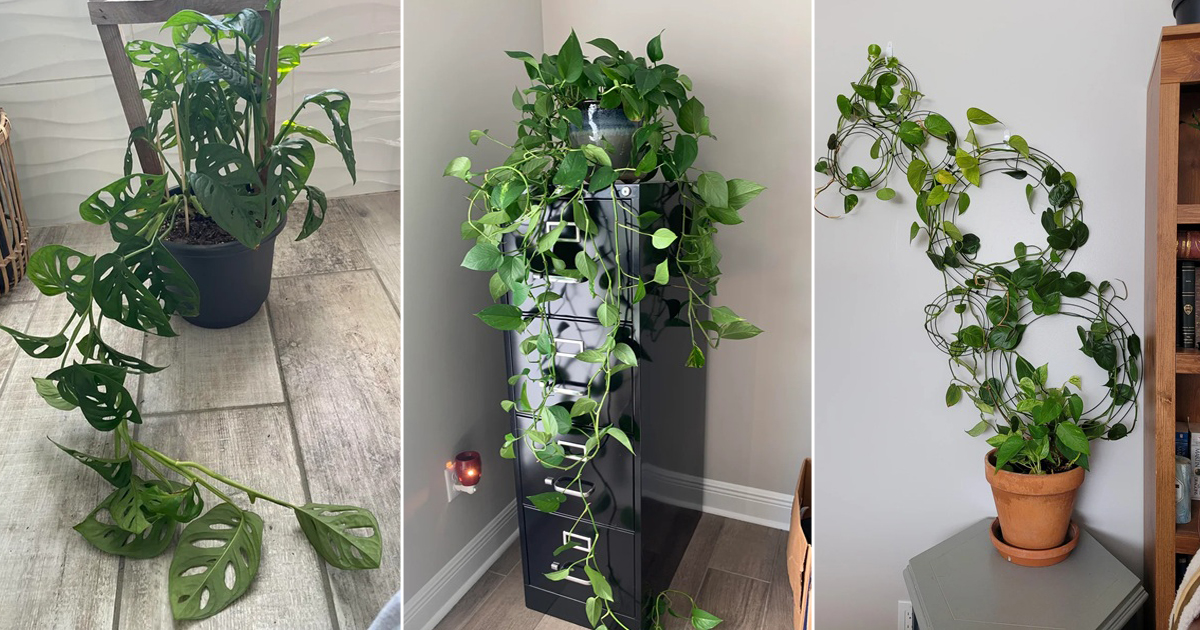
Do you wonder why your indoor vines look thin? Read on to know the answer and also learn how to make them lusher.

Indoor vines are meant to drape beautifully and create a cascading effect, but if yours look thin and sparse, you need to act! Here are some amazing and easy-to-execute gardening tips to ensure you plant stays lush.
Why Indoor Vines Look Thin
1. Lack of Light

If your indoor vine is looking sparse, chances are it is light-starved. Yes! Light plays a vital role in all plants’ metabolism, and a lack of it can mean poor health. When growing vines like Pothos or Philodendron, they tend to stretch out desperately under conditions where there isn’t enough sunlight.
This will leave you with long, leggy growth and few leaves, which is exactly when these vines will look thin. The best way is to give your vine a good location as per its light requirement. You should also move it closer to a bright window where it gets bright indirect light.
Pro Tip: If your room is as gloomy, you should introduce a grow light to keep those leaves popping. Rotate your plant every few weeks so all sides get equal light exposure.
Here’s another one: If the distance between leaves (internodes) keeps increasing, that’s a clear sign the plant is reaching for light; even if it’s “surviving.” Survival is not healthy growth.
2. Lack of Pruning

Just like skipping haircuts makes your hair look unhealthy, not pruning your vine makes it look sparse and weak. Vines like Hoya, Pothos, and Swedish Ivy are notorious for growing long and bare stems if left unchecked.
When your indoor vines grow too long without trimming, they will focus energy on length rather than producing new leaves, which will lead to a thin appearance.
Be an active gardener and trim the vine just above a leaf node to encourage side shoots and fuller growth. Always prune above a node that still has healthy leaves; cutting too close to a bare section may not trigger branching.
Pro Tip: Remember the proper timing, and always trim in early spring or the growing season for the best results.
3. Low Humidity
Vines like Philodendron Micans and Pothos thrive in humidity ranges of 50%-70%, and if the humidity drops below 40%, it is a problem. In such a condition, your vines will struggle to retain moisture, which will lead to weak and crispy-edged growth.
Therefore, if your vine’s leaves look thin and sad, the air might be dry around it, which forces vines to focus on survival rather than on lush foliage. To address this, you can boost humidity with a pebble tray and a proper misting technique.
You can also group your plants together for a mini jungle effect, which naturally increases moisture in the air.
Pro Tip: Place your vine in a bathroom for an easy humidity hack. Also, mist the air around the plant, not just the leaves—humidity works when it stays in the space, not when it evaporates instantly.
4. Wrong Pot Size

If the pot size of your vine is too big, the roots will get overwhelmed, and growth will slow down. It is because your plant will focus on more roots instead of healthy vines. In the case of a small pot, the plant becomes root-bound, which restricts nutrient and water absorption and leads to stunted growth.
The most popular vines, like Heartleaf Philodendron and String of Pearls, need just the right space to flourish. A “too-tight” pot can also dry out faster, which stresses the plant, leading to thin vines.
Remember, if your soil stays wet for more than 5–6 days after watering, the pot is likely too large or poorly draining.
The Simple Fix: Pick a pot that is just 1-2 inches larger than the root ball to maintain a balanced root-to-soil ratio. Depending on the plant’s growth and variety, you should repot the plant every few years.
5. Lack of Support
Some vines are natural climbers like Monstera Peru and Pothos, but without proper support, they sprawl outward, trailing weakly instead of growing lush and compact. In nature, these plants climb trees and use their aerial roots to anchor themselves and reach for better light.
If there is no vertical structure to cling to, your vines will direct energy into long, leggy growth instead of producing dense foliage. If the vines are showing signs of weak growth, it is time to give them something to climb.
A moss pole, bamboo stake, or even wall-mounted command hooks can encourage upright growth and fuller foliage. You can also wrap aerial roots around a moist moss pole and mist it regularly to trigger stronger attachment and lush leaf production.
Did you know? Leaves often grow noticeably larger once a vine starts climbing. This is a biological response, not a coincidence.
6. Lack of Fertilizer
If you never feed your plant, expect thin, weak growth. Vines like Swiss Cheese Plant, Neon Pothos, and others need a steady supply of nutrients to produce healthy leaves. Without adequate fertilization, your plant will struggle to generate new foliage, which results in leggy stems with fewer leaves.
Since your indoor plants don’t have access to natural soil nutrients like outdoor ones, regular feeding is essential to keep them thriving. You should use a balanced liquid fertilizer (like 10-10-10) once a month during the growing season (spring and summer) to provide essential macronutrients.
You can also give them an organic nutrient boost like compost tea, banana peel water, or diluted fish emulsion.
Pro Tip: If your plant is looking particularly sluggish, give it a quick dose of seaweed or kelp extract.
7. Inconsistent Watering Habits

When vines like Pothos, Philodendron, and Scindapsus go through repeated cycles of extreme dryness followed by heavy watering, their growth becomes unstable. Instead of producing steady, leafy growth, you will see the plant shifting into stress mode, resulting in weak stems and fewer leaves.
Overwatering can suffocate roots and reduce oxygen uptake, while underwatering will cause vines to conserve energy by slowing leaf production. Both situations lead to sparse, stretched-out growth that makes your vines look thin and tired. Remember that the key is consistency!
Watering Tip: Water only when the top inch of soil feels dry and ensure excess water drains completely. You should always check soil moisture with your finger before watering and stick to a routine rather than watering randomly.
If your indoor vines are looking thin, the good news is that small, consistent changes can quickly bring them back to life.


