
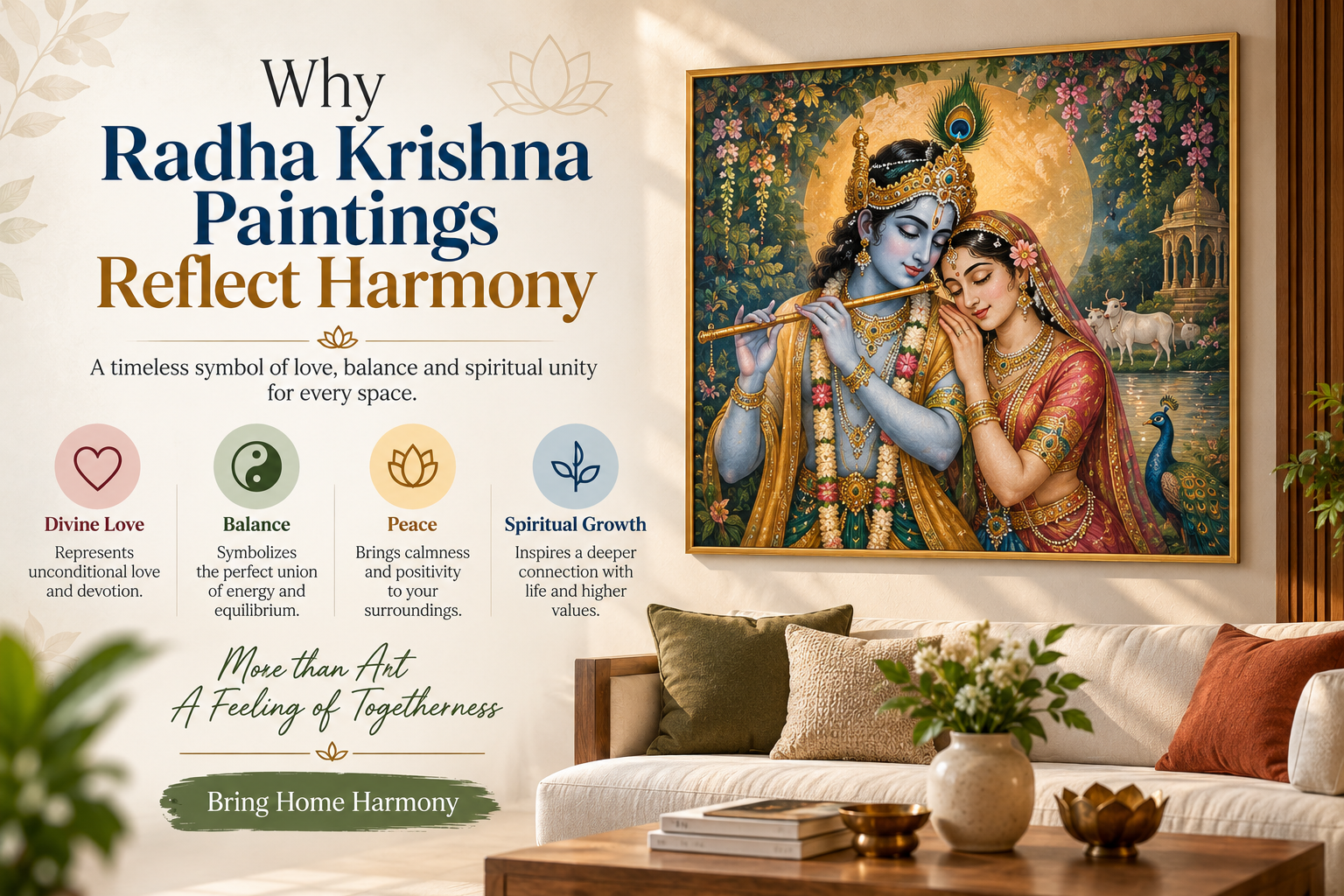
Radha Krishna imagery is widely associated with harmony through themes of devotion, affection, companionship, and spiritual connection. Artists often express this relationship through balanced compositions, coordinated gestures, gentle expressions, musical imagery, and peaceful natural settings. A painting may combine these visual elements to suggest unity without reducing the subject to decoration alone. For many viewers, Radha Krishna art carries devotional and cultural significance while also offering a graceful visual presence within residential interiors.
Why Radha Krishna Imagery Represents Harmony
Radha and Krishna appear together in many devotional and artistic traditions, where their relationship commonly represents deep devotion and spiritual closeness. Paintings often place the two figures in a visually connected arrangement, allowing posture, gesture, and expression to reinforce a sense of companionship.
Harmony may also appear through the way artists balance both figures within the composition. Similar scale, coordinated positioning and shared visual attention can create unity, while contrasting clothing or colours can keep each figure distinct.
Moreover, the symbolic meaning depends on artistic tradition, cultural context, and individual interpretation. A painting can communicate devotion and balance without implying that displaying it guarantees specific outcomes in relationships or personal life.
How Artistic Elements Express Unity and Balance
Artists can communicate harmony through several visual devices rather than relying on one fixed symbol.
Expressions, Gestures and Positioning
Facial expressions and body language often shape the emotional character of a Radha Krishna painting. Gentle expressions, shared attention, or complementary poses may contribute to a calm and connected composition.
Similarly, the space between the figures matters. Close positioning can create visual intimacy, while a more open arrangement may emphasize the surrounding landscape and overall balance.
Clothing, jewellery and decorative details can also create rhythm when artists coordinate patterns and colours across the composition.
The Role of Krishna’s Flute
Krishna’s flute frequently appears in artistic representations and is traditionally associated with his identity. Within a painting, the flute can also function as a strong visual element that links gesture, posture and rhythm.
Musical imagery may contribute to a sense of flow, especially when the composition includes curved lines, flowing garments, or surrounding foliage. However, viewers should avoid assigning one rigid meaning to every flute depiction, since artistic interpretations can vary.
Nature as Part of the Harmonious Composition
Natural settings often support the atmosphere of Radha Krishna artwork. Trees, flowers, water, gardens, moonlight, and pastoral landscapes can provide a peaceful visual setting around the central figures.
Flowers, Trees and Water
Floral elements can soften the composition and introduce repeated shapes or colours. Trees and greenery may frame the figures, while rivers or ponds can create horizontal balance and visual depth.
Meanwhile, moonlit or garden scenes can contribute to a quieter visual character. These elements work primarily through composition, colour and setting, although particular traditions may attach additional devotional meanings to them.
The relationship between figures and surroundings often creates a stronger sense of harmony than any single decorative feature.
How Colour Influences the Painting’s Character
Colour can strongly affect the visual tone of a Radha Krishna painting. Artists may use contrasting or complementary shades to separate the figures while maintaining cohesion across the canvas.
Warm colours can create richness and visual prominence, while cooler tones may make the composition feel softer or more restrained. Gold, green, blue, pink, red, and earthy shades often appear in different artistic styles, but their exact meaning should not be treated as universal.
Additionally, repeated colours across clothing, flowers, and backgrounds can connect separate parts of the artwork and strengthen visual balance.
Traditional and Contemporary Interpretations
Radha Krishna paintings can range from highly detailed traditional compositions to simplified contemporary designs. Both approaches can communicate harmony, although they use different visual languages.
Traditional styles may emphasize intricate clothing, ornaments, landscapes, and decorative motifs. Contemporary interpretations may rely more heavily on abstraction, simplified forms, bold colour fields, or minimal backgrounds.
Therefore, buyers should consider whether they prefer visual detail, cultural ornamentation, or a more restrained aesthetic. The most suitable choice depends on personal taste and the surrounding interior.
Using Radha Krishna Paintings in Home Interiors
A culturally meaningful painting should feel respectful while also fitting the room’s proportions, colour palette, and visual hierarchy.
Choose the Right Size and Placement
Measure the available wall before selecting a canvas. A large painting may suit a broad wall in a living or dining area, while a smaller piece can work better in a compact room or focused display zone.
Consider:
-
Wall width and height
-
Furniture dimensions
-
Viewing distance
-
Existing wall décor
-
Lighting conditions
-
Frame thickness
-
Surrounding decorative objects
Avoid placing a large painting where furniture or architectural elements visually crowd it. Similarly, excessive artwork around the piece can weaken its prominence.
Match the Artwork With Existing Décor
Look for colours within the painting that relate naturally to upholstery, curtains, rugs, wall finishes or accessories. Exact colour matching is unnecessary; coordinated tones or deliberate contrast can work equally well.
For example, a richly detailed traditional composition may suit interiors with carved furniture or layered decorative elements. In contrast, a simplified canvas may fit cleaner, contemporary spaces more comfortably.
Practical Buying Considerations
Readers planning to buy radha krishna canvas painting online should evaluate both the visual design and the product details before making a decision.
Check:
-
Exact artwork dimensions
-
Canvas material
-
Hand-painted, printed, or digitally reproduced format
-
Image clarity
-
Colour appearance
-
Frame or frameless presentation
-
Edge finishing
-
Product photographs
-
Hanging requirements
-
Care instructions
-
Packaging details
-
Return conditions
Screen settings can affect colour appearance, so compare the overall palette rather than expecting an exact digital match.
Common Selection Mistakes
A painting can lose visual impact when its size, style or colours conflict with the room. Common mistakes include selecting an oversized canvas for a narrow wall, choosing artwork without measuring available space, and surrounding the piece with too many unrelated decorative elements.
Moreover, buyers should avoid making decisions based solely on symbolic claims. Artistic meaning, devotional significance, and interior suitability should remain distinct considerations.
Conclusion
Radha Krishna paintings can express harmony through devotion, companionship, colour, balanced composition, musical imagery and natural surroundings. Their appeal comes from both cultural significance and artistic structure, although interpretations can vary across traditions and viewers. Careful choices around size, style, colour and placement allow the painting to retain visual dignity while fitting naturally within a home. Symbolic meaning can enrich the artwork, but it should not be treated as a guarantee of specific real-life outcomes.
FAQs
Why do Radha Krishna paintings symbolize harmony?
Radha Krishna imagery commonly represents devotion, companionship, and spiritual connection. Artists often reinforce these themes through coordinated gestures, balanced positioning, complementary colours, and shared visual focus. The symbolic meaning remains cultural and devotional rather than a guarantee of harmony in everyday life.
What does Krishna’s flute represent in Radha Krishna artwork?
Krishna’s flute is closely associated with his traditional artistic identity. Within a painting, it can also contribute to rhythm, gesture, and visual flow. Its symbolic interpretation may vary, so viewers should avoid assigning one fixed religious meaning to every depiction.
How should I choose a Radha Krishna painting for my home?
Consider the wall dimensions, furniture proportions, existing colour palette, lighting, and desired artistic style. Choose a composition that feels respectful and visually balanced. Traditional detailed paintings and contemporary simplified designs can both work well when they suit the surrounding interior.
What should I check before buying a Radha Krishna canvas painting online?
Check dimensions, canvas material, image clarity, printing or painting technique, framing, edge finishing, and care requirements. Review photographs closely and confirm whether the piece is hand-painted, printed, or digitally reproduced. Also consider packaging and return conditions before purchase.


