
Jonathan, the world’s oldest living land animal, has earned another Guinness World Records title!
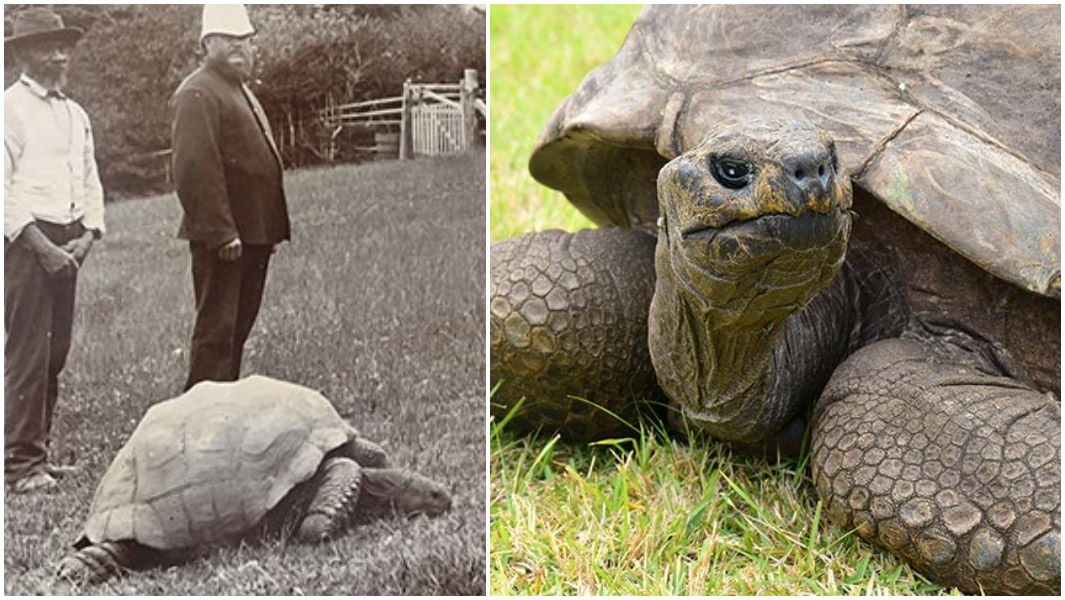
Celebrating his 190th birthday this year, Jonathan is now the oldest tortoise ever.
His official record title is oldest chelonian – a category which encompasses all turtles, terrapins and tortoises.
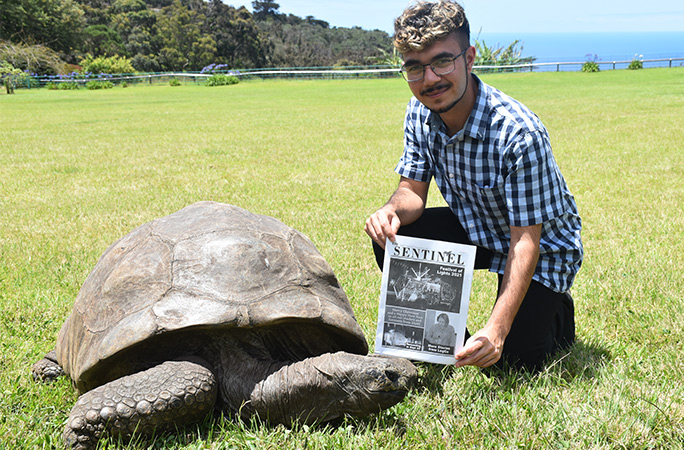
Jonathan the tortoise pictured in December 2021
Jonathan has “come through the winter well”, as per an update from the St Helena Government. “He grazes well now, but is unaware of food if we simply place it on the ground.”
“The Veterinary Section is still feeding him by hand once a week to boost his calories, vitamins, minerals and trace elements, as he is blind and has no sense of smell.”
“His hearing though is excellent and he loves the company of humans, and responds well to his vet Joe Hollins’ voice as he associates him with a feast.”
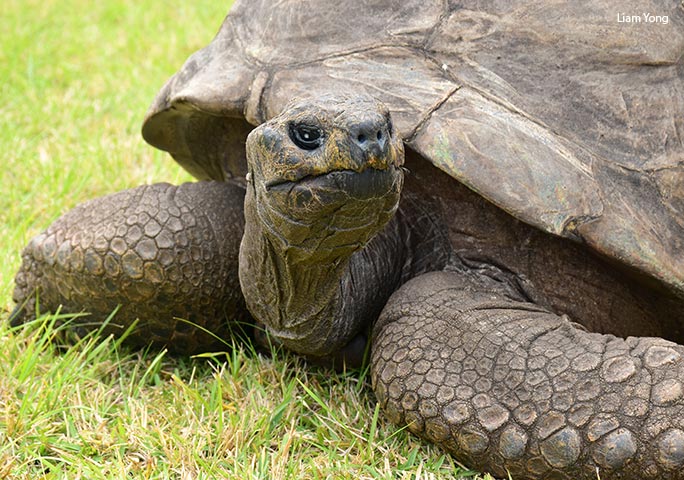
The previous oldest chelonian was Tu’i Malila, a radiated tortoise that lived to be at least 188. Presented to the royal family of Tonga by Captain Cook c.1777, Tu’i Malila remained in their care until its death in 1965.
Jonathan is believed to have been born c. 1832, thus making him 190 years old in 2022.
Jonathan’s age is an estimation based on the fact that he was fully mature, and hence at least 50 years old, when he arrived in St Helena from the Seychelles in 1882. In all likelihood, he is even older than we think.
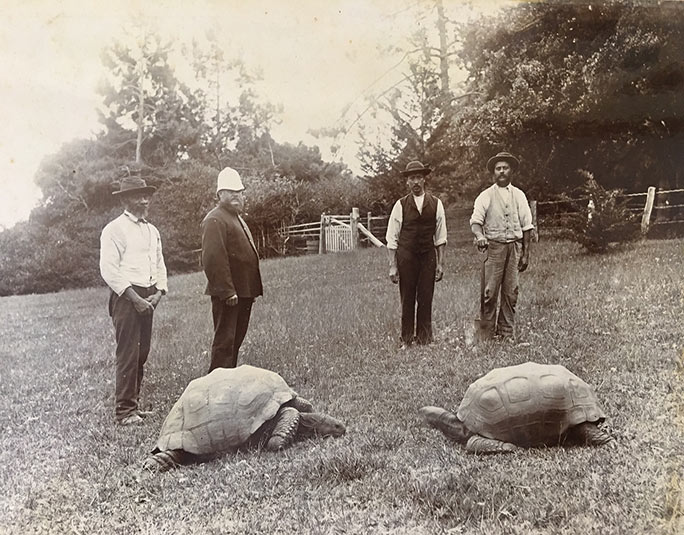
Jonathan (left) c.1882-86, on the grounds of Plantation House, St Helena
His estimated age was further supported when an old photograph taken between 1882 and 1886 was uncovered. It showed a fully-grown Jonathan grazing on some grass in the garden of Plantation House – the residence of the Governor of St Helena, where Jonathan has spent most of his life.
Since Jonathan was gifted to Sir William Grey-Wilson all those years ago, 31 more governors have come and gone. Jonathan is still plodding around the same grounds today, where he enjoys the company of three other giant tortoises: David, Emma and Fred.
“He is a local icon, symbolic of persistence in the face of change,” – Joe Hollins, Jonathan’s vet
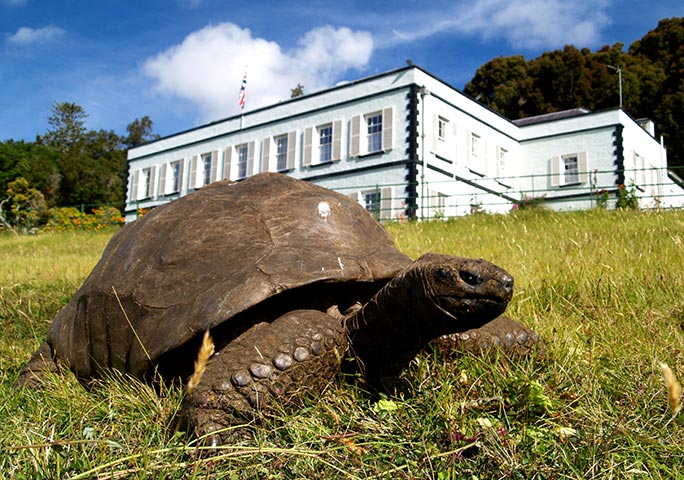
Jonathan has lived through some major human milestones, such as:
• 1838 – the first photograph of a person was taken
• 1876 – the first telephone call was made
• 1878 – the first incandescent lightbulb was invented
• 1887 – the Eiffel Tower, the world’s tallest iron structure, was completed
• 1903 – the first power-driven flight took to the skies, flown by the Wright brothers (both USA)
• 1969 – Neil Armstrong and Buzz Aldrin (both USA) became the first people on the Moon
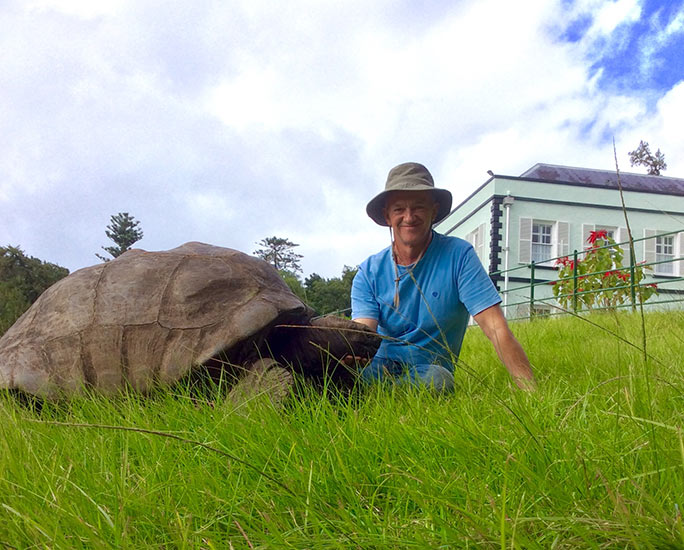
Jonathan with his vet, Joe Hollins
As the world around him evolved and advanced, Jonathan remained the same. To this day, his main interests are sleeping, eating and mating.
According to vet Joe, Jonathan “enjoys the sun but on very hot days takes to the shade. On mild days, he will sunbathe – his long neck and legs stretched fully out of his shell to absorb heat and transfer it to his core.”
When it’s cold, the world’s oldest tortoise prefers to “dig himself into leaf mould or grass clippings and remain there all day.”
Despite some of his senses now failing him, such as his sight and smell, Jonathan still seems to have plenty of energy left!
“In spite of his age, Jonathan still has good libido and is seen frequently to mate with Emma and sometimes Fred – animals are often not particularly gender-sensitive!” Joe revealed.
Among Jonathan’s favourite foods are cabbage, cucumber, carrot, apple and other seasonal fruits.
“He loves banana, but it tends to gum up his mouth. Lettuce hearts, though not very nutritious, are a favourite.”
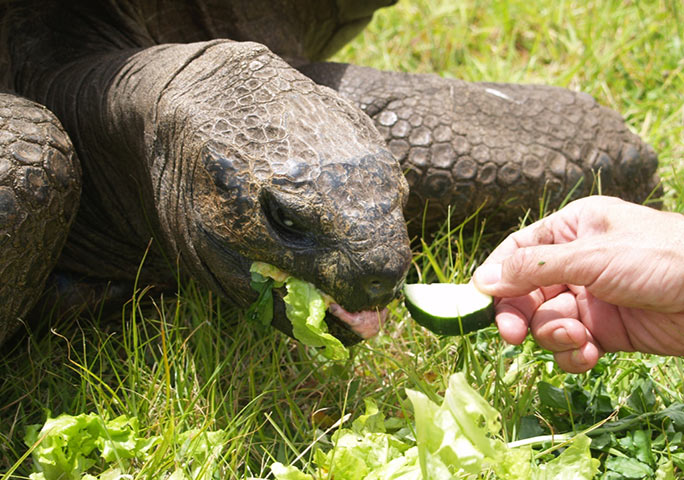
We wish Jonathan a very happy 190th year full of his favourite treats!


