
You’re ready to start fermenting! GREAT! Now, where do you begin? Here’s an in-depth look at the best fermentation vessels for safe, affordable, and easy fruit and veggie ferments like garlic-dill pickles, carrot sticks, radishes, and sauerkraut.
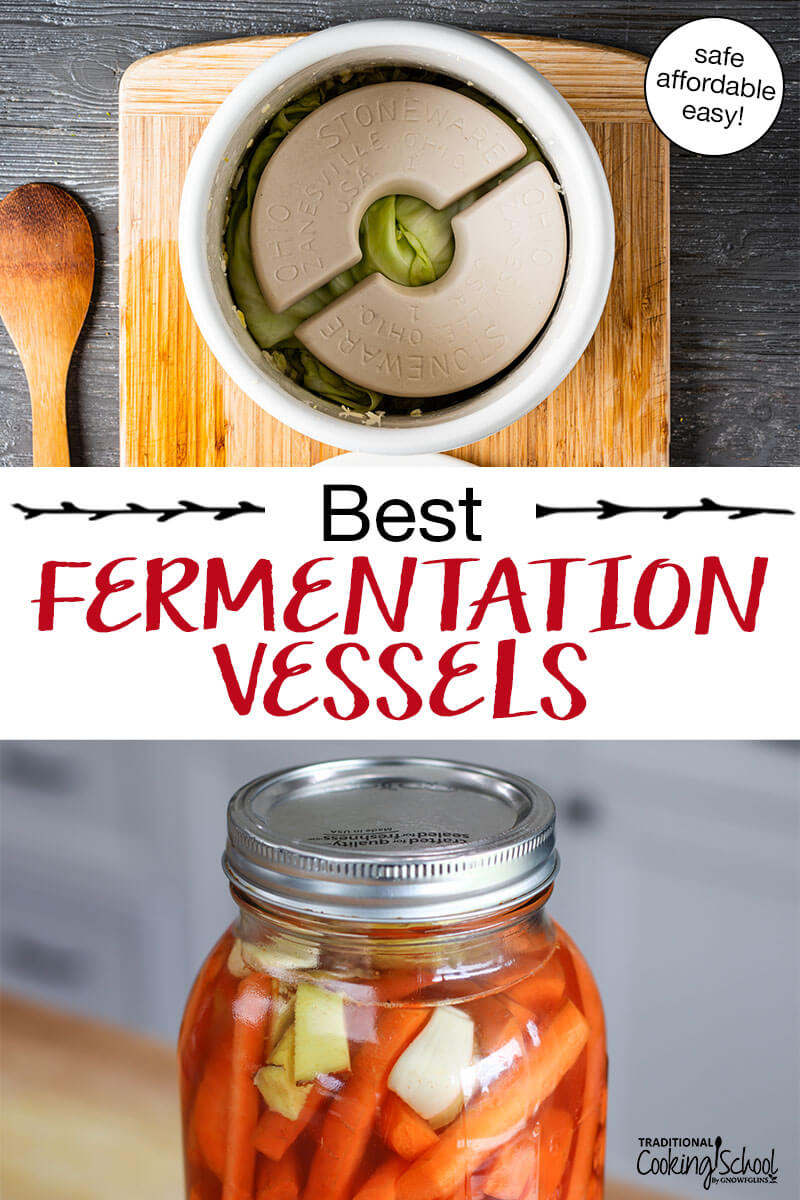
MYTH: You need special equipment to ferment.
Not at all!
Although wooden pounders, fermenting weights, fermenting lids, crocks, etc. are all very nice… you can do without. You can use what you already have, whether that’s jars, crocks, bowls, wooden barrels or buckets (preferably food grade).
Whatever you choose, the main idea is to make the container as air-tight as possible, and keep the food submerged under the level of the brine.
Let’s cover some fermenting basics and then I’ll share my favorite fermenting vessels!
Table Of Contents
What is fermentation?
The fermentation process starts with beneficial organisms called Lactobacilli. These are bacteria that produce lactic acid (and carbon dioxide) as a byproduct of consuming the starches and sugars in food. As they grow and proliferate throughout the food (making it probiotic), they boost vitamin and enzyme levels.
You can lacto-ferment fruits, vegetables, grains, beans, meats, dairy, beverages, condiments and more (all of which we cover in our Lacto-Fermentation eCourse).
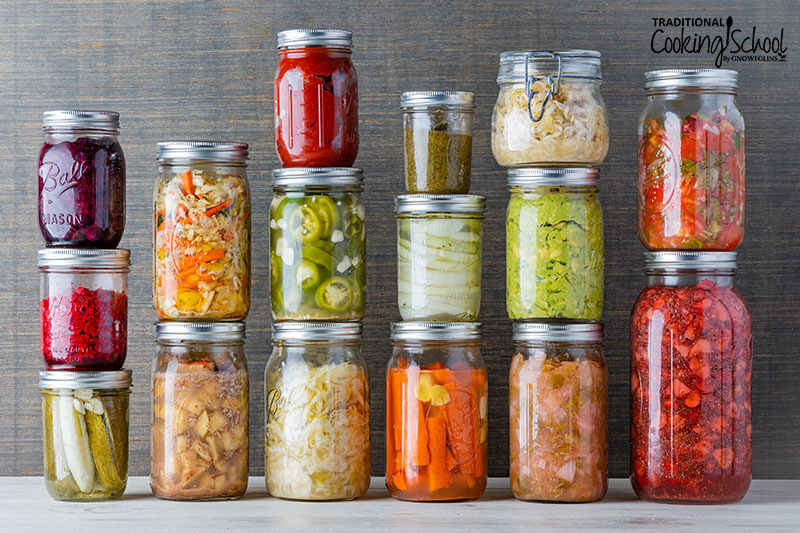
Why Fermentation Vessels Matter
Generally, lacto-fermentation is an anaerobic process; it requires an oxygen-free environment. If oxygen is present, the wrong organisms flourish instead of the friendly bacteria and/or yeasts we want to cultivate.
You might notice whitish or other colored growths on the top of your ferments at times (especially during warm weather). This is an over-growth of oxygen-loving yeast (not harmful) or spoiling organisms, right at the surface. Neither of these are the right organisms for lacto-fermentation. They can lend off-flavors to your ferments or cause them to spoil.
So, it’s important to choose fermentation vessels that support the growth of friendly bacteria instead of spoiling organisms. The best fermentation vessels are air-tight. Which leads me to our next question…
Should fermenting vessels be air-tight?
Some ferments (sourdough and cultured dairy) need oxygen, but most don’t and shouldn’t. For the fermentation that doesn’t need oxygen, ideally you should seal up the vessels completely to minimize the contact with spoiling organisms from the outside.
You can, and people do, use other containers which are not air-tight. For example, if you’re using a crock from Goodwill that comes without a lid. Or some people make sauerkraut in big bowls and weigh the sauerkraut down with a rock on top of a plate — obviously exposed to the air at least around the edges of the plate.
In these situations, keeping the food away from oxygen means getting creative. In past or recent history, people employed various solutions, such as wooden planks, plates with plastic bags full of water on top, and other things. These setups should be checked for mold at the surface regularly. Usually, the mold will not trickle down further if other conditions are right.
The basic idea is to keep the spoiling organisms in the outside air away from your ferment. Yet, even if you use an airlock jar there are no guarantees. The top of the ferment is still exposed to the air in the jar. Don’t worry, mold isn’t as scary as it sounds. I walk you through how to prevent moldy ferments and what to do if it happens, including how to tell if they are safe to eat or not, in this article.
A general rule: Let your nose be your guide. If the fermenting food smells spoiled, it probably is. Toss it. If you need more help, here is my in-depth guide to troubleshooting ferments.
How do fermentation vessels work?
Some are completely air-tight (such as Mason jars). Others have a water barrier which keeps outside air out, yet allows gases produced by the fermenting organisms to escape (such as airlock jars and some crocks).
My Favorite Fermenting Vessels
I like to keep my kitchen and its implements simple. 😉 So I opt for simple fermenting vessels — a few special airlock lids and crocks, and lots of canning jars!
Whatever you choose, keep in mind the idea of the brine and keeping food submerged. Glass and lead-free ceramic are best. Avoid plastic, as the acids in the fermented foods may leech plastic into your food.
Here are my favorite fermenting vessels. They are all air-tight, as that is my preference. (However, I don’t use air-tight containers for sourdough or cultured dairy.)
1. Mason Jar with Metal Band and Lid
We’ve all got Mason jars, and they come in a variety of sizes to suit your fermenting needs!
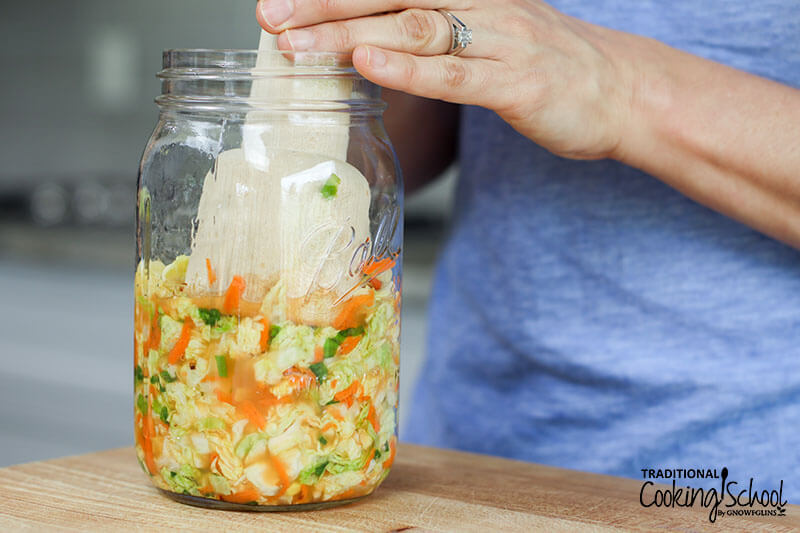
Leave 1 inch of space at the top for the production of acids and gases, and be sure to cap tightly with the metal band and lid. Burp the jar daily to release pent-up gases, or you may have an explosion on your hands (especially in warm weather). You may also need to tamp the fermented foods back down underneath the level of the brine (pictured above).
You can use a clean regular mouth lid right inside a wide-mouth jar to hold the veggies or fruit down and even weigh it down with a glass of water (just heavy enough to press the food down under the brine but no more) or a clean, sterilized rock.
Pros: Inexpensive, versatile and many sizes.
Cons: Burping the jar releases somewhat stinky (but not harmful) odors. Built-up pressure can cause explosions or very bubbly mixtures. Use of metal band and lid may be reactive with acids in fermentation and/or may contain BPA. You need to come up with your own weights for buoyant foods.
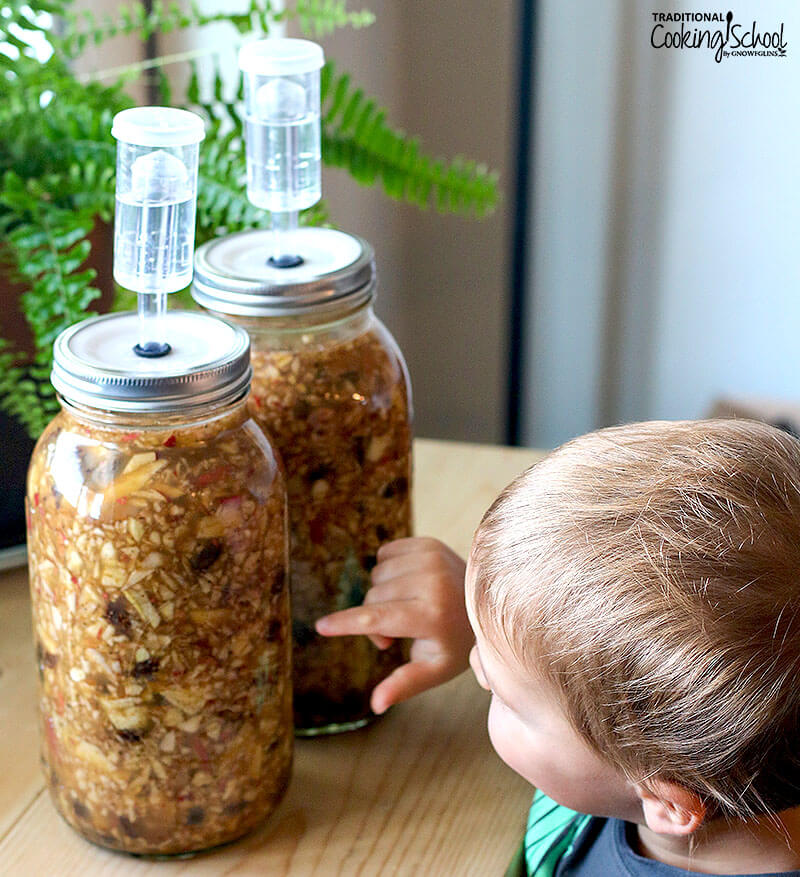
2. Airlock Jars
To upgrade your Mason jar set-up, you can purchase an airlock lid that uses a water barrier to keep outside air from entering the jar, yet allows fermenting gases to escape. My favorites are the Pickl-Pro lids from Homesteader Supply and the Fermented Vegetable Master from Cultures for Health.
The lids are not metal but rather food-grade plastic. 1 inch of head space is necessary here, too. Whenever I push the limit, I end up with very happy kraut juice all over my counter. Be sure to press down the ferment so it stays submerged under the brine, too.
You can also make your own (very inexpensive) DIY airlock solution!
Pros: Food-grade plastic lid rather than reactive metal, versatile and many sizes. Airlock allows fermenting gases to escape while keeping outside air out. This eliminates the need to burp container, protects against explosions, and reduces stinky smells.
Cons: More expensive, though not terribly so. Do not include weights for food, though there are exceptions.
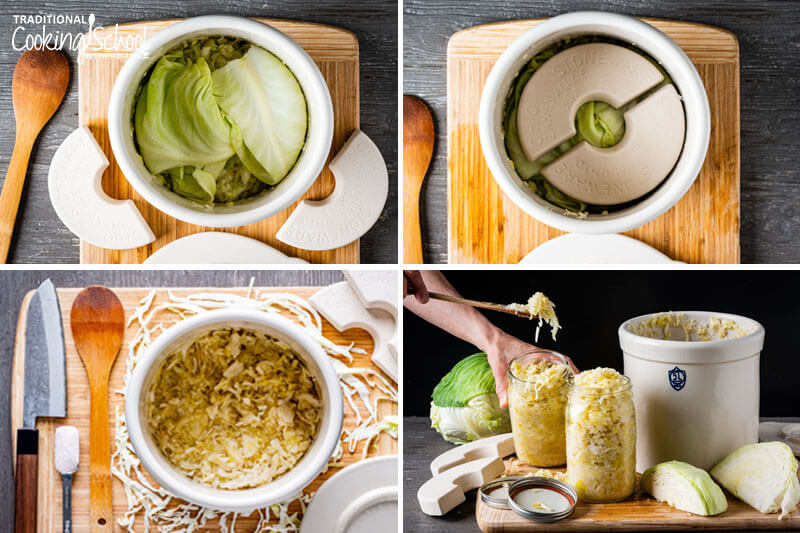
3. Fermenting Crocks
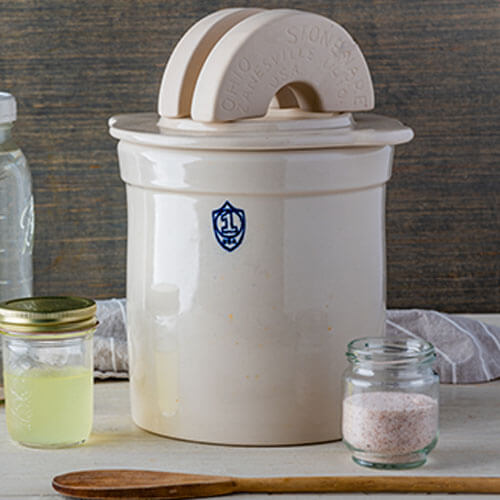
Fermenting crocks are cream of the crop. They are more expensive than Mason jars, yet can still be affordable. The crocks have weight stones to submerge the food below the brine. A water gutter allows fermenting gases to escape but prevents outside air from getting in. You need to leave room at the top here as well, enough for the weight and for brine and acids.
Ohio Stoneware is my favorite brand of stoneware fermentation crocks. Their USA-made products are fantastic and affordable. I demonstrated how to use their 1-gallon crocks to make homemade sauerkraut here. They also have larger traditional style crocks with a water gutter to keep them air-tight (we have a 3 gallon size of that style).
Follow the links below to check out their stoneware fermentation crocks for yourself!
- Complete 1-gallon kit from Ohio Stoneware — includes crock, weights, and lid (pictured above)
- 1-gallon crock from Ohio Stoneware
- Lid for 1-gallon crock from Ohio Stoneware
- Ohio Stoneware weights for 1-gallon crock
Pros: Versatile and many sizes. Can include weights. Water gutter allows fermenting gases to escape while keeping outside air out — eliminates need to burp container, protects against explosions and reduces stinky smells.
Cons: More expensive. Water gutter must be refilled on a regular basis, depending on speed of evaporation.
Other Fermentation Posts You May Enjoy
Feel free to check out these fermenting articles and recipes, all found in our fermenting archives!
- What Is Lacto-Fermentation? {Video}
- 5 Tips: How To Prevent Mold During Fermentation #AskWardee 074
- How To Make Lacto-Fermented Radishes
- Homemade Sauerkraut In A Stoneware Crock
- Lacto-Fermented Carrot Sticks (gut-healing probiotic snack for kids!)
- Old-Fashioned, Crunchy, Fermented Garlic-Dill Pickles
What are your favorite fermentation vessels?


