
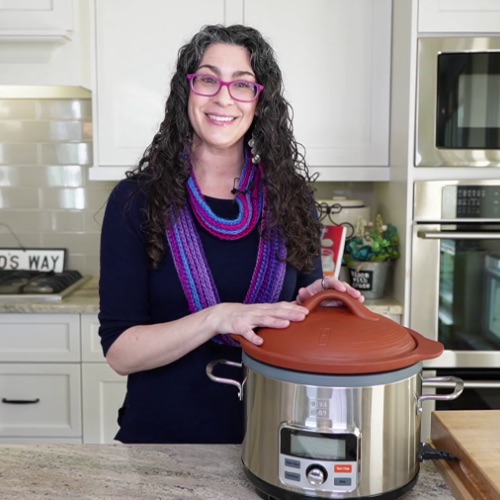
Are you on the fence about the VitaClay cooker? What does it do? How does it compare to the Instant Pot? Do you really need one more kitchen appliance? Here’s my updated review of VitaClay cookers, including the brand-new Nourishing Pot that combines the best of previous models, plus why you might choose one, which model to buy, and how it compares to pressure cooking.

Are you on the fence about the VitaClay cooker?
What does it do? How does it compare to the Instant Pot? Do you really need one more kitchen appliance?
Here’s my updated review of VitaClay cookers, including the brand-new Nourishing Pot that combines the best of previous models, plus why you might choose one, which model to buy, and how it compares to pressure cooking.
Table Of Contents
Why I Love My VitaClay
I use our VitaClay cooker practically every day!
I soak whatever I’m making, of course, whether grains or beans, pop them in, turn it on, and voila… gorgeous cooked grains, soups, broth, and more! So easy. I use it as often as I do our Instant Pot, and sometimes more. I use it ALL the time!
The clay cooking pot is non-toxic… no lead, no non-stick, nothing to react or worry about. And the cooker itself just works. If I had to describe its functionality, I would say it’s between a slow cooker and a pressure cooker. Faster and hotter than a slow cooker… about 1/5 of the time… yet not high pressure like the Instant Pot.
Below, I’ll share my review of the VitaClay cookers, in video and print form, plus a recipe at the end for my favorite breakfast cereal using the Nourishing Pot!
Nourishing Pot Review +Apple-Blueberry “Cream of Wheat”
Old Review Video: the Multi-Cooker v. Multi-Crock
VitaClay Review: The Benefits
1. It’s 5 to 6 times faster cooking than a slow cooker.
Because the VitaClay outer container seals up and insulates the cooking environment, you don’t get as much heat loss as with a slow cooker. Therefore, your dishes cook faster.
However, if you work outside the home, and you LIKE putting your ingredients in a slow cooker and knowing that you’ll walk in the door at night knowing it’s perfectly done, perhaps the VitaClay being 4 to 5 times faster isn’t the best option for you… 8 hours in a slow cooker is a better fit for you.
Note: There is an automatic warm function for 9 to 12 hours (depending on model) if your food is done way early. For food safety reasons, we recommend keeping foods on warm for no more than 2 hours.
2. It retains heat better than a slow cooker.
This is not only because of the outer insulated cooking unit, as I just mentioned, but also because a slow cooker often has a hole in the lid that vents heat.
3. You can open and close the VitaClay more often than a slow cooker or pressure cooker during cooking.
If you open and close a slow cooker frequently, you’ll add tons of time to your recipe. And you simply can’t open and close a pressure cooker when it’s under pressure. So you have an advantage here of being able to stir and/or check on how your dish is doing without significant downsides. Having said that, when you’re doing a traditionally “soaked” recipe such as soaked rice or other grains, soaked oatmeal, or soaked porridge, I don’t recommend opening and closing the VitaClay cooker to ensure a better result. You’re more likely to get maximum water absorption, rather than under or over, if you don’t open and close.
4. You don’t have to wait for pressure changes.
With a pressure cooker, you not only have to wait for it to come up to pressure, you also have to wait for pressure release. These aren’t a big deal if you’re planning for them, but if you’re in a hurry, these wait times can seem impossibly long and inconvenient when you’re stuck… just waiting!
5. Hands-free cooking.
Like a slow cooker or pressure cooker, the VitaClay is also hands-free. We sure love our “set it and forget it” appliances, don’t we? This is another one you can love, and given that it’s faster than a slow cooker and you’re not locked out when under pressure, like with a pressure cooker, it can seem like the very best of all. At least in certain situations.
6. The unglazed clay insert pot is arguably the least toxic of all our cooking options.
Those stainless steel pots and/or insert pots for slow cookers and pressure cookers are generally regarded as safe (and I would agree), yet stainless steel is still minimally reactive, especially with acidic foods and longer cook or soak times. With slow cookers, many of the ceramic cooking pots or coatings are found to contain lead or other toxins in the pot themselves or the coating. On the other hand, the VitaClay clay cooking pot is not reactive at all, is bare clay (no coating), and has no toxic heavy metal contamination, period.
However, the darker colored clay pots have more iron oxide, so if iron overload is an issue for you, you may want to choose the VitaClay stoneware multi-crock instead of the clay multi-cooker. I will say, though, that I am watching my iron closely and my iron has only gone down during the year I’ve been using the VitaClay cooker day in and day out. My iron was too high and now it’s doing very well… all while using this cooker. I think potentially that’s because I don’t often cook acidic ingredients, which might react and pull iron into the food. Just food for thought.
Please note: some models of VitaClay offer a lead-free stoneware pot, which is better than slow cookers’ insert. However, I recommend the clay option anyway, due to winning my vote as being guaranteed non-toxic.
7. Moist, moist, moist. Flavor, flavor, flavor.
Due to the sealed cooking environment and the natural ability of clay to create tender and moist dishes, you’ll love the meats, grains, and soups/stews that come out of your VitaClay cooker.
8. Versatility.
With the exception of being able to make “dry” dishes (pressure cooker is the same), you can make a lot of moist “wet” dishes in your VitaClay cooker! Soaked grains and beans, soups, stews, broth, porridges, desserts, yogurt, and steamed veggies.
To shop VitaClay and save, use this link: TradCookSchool.com/vitaclay and code WARDEE10 will get you a good deal! The link takes you to the VM7900-8 multi-cooker (my favorite) but feel free to click around if you prefer another model.

Which VitaClay Should You Buy?
Currently, the VitaClay collection includes three major styles of cookers: the multi-cooker, the new Nourishing Pot, and the now-discontinued multi-crock. They also have a stand-alone rice cooker, but I’m choosing not to cover that because the other models are the most versatile.
The Clear Winner: The Nourishing Pot
If you’re shopping for a new VitaClay cooker today, I recommend the Nourishing Pot without hesitation. Here’s why:
It combines the best of both previous models: You get the rice modes and delay functions of the multi-cooker PLUS the larger 6.5-quart capacity (upgraded from the multi-crock’s 6 quarts).
Plus, brand-new exclusive modes not available on older models:
- Oats mode — perfect for steel cut oats, rolled oats, or cracked grain cereals
- Bone Broth mode — designed for traditional cooks who want rich, nourishing broth (3-24 hours)
- Artisana mode — completely customizable temperature (75-185°F) and time (1-24 hours) for fermenting, bread proofing, herbal decoctions, and more
- One Pot Meal mode — ideal for smaller 2-4 serving meals
- Egg Boil mode — for perfect eggs every time
- Slow Low mode — perfect for tough cuts of meat, casseroles, and dishes needing longer, slower cooking
- Manual Keep Warm function — unlike the multi-crock, you can manually enter Keep Warm mode
- Delay functions on most modes (about half) — the multi-crock offered delay on only one mode
What About the Older Models?
The multi-crock is now discontinued, so it’s no longer an option for new buyers (though you might find one at thrift stores!).
The multi-cooker is still available and remains a solid choice if you prefer the oval shape or smaller 4-quart capacity. However, given that the Nourishing Pot offers everything the multi-cooker does PLUS the larger capacity and new modes, most families will be happier with the Nourishing Pot.
To shop VitaClay and save, use this link: TradCookSchool.com/vitaclay and code WARDEE10 will get you a good deal! The link takes you to the Nourishing Pot (my favorite) but feel free to click around if you prefer another model.
VitaClay v. Instant Pot
I have reviewed Instant Pot models in the past. If you could only purchase a VitaClay or an Instant Pot, which would you choose? That is YOUR choice to make and only you know what is best for you. Yet in this VitaClay review, I can give you some factors to consider. Here’s what I would take into consideration:
- The Instant Pot wins with being the fastest overall and certain models giving you larger capacity (8- or 10-quart). Additionally, you can sauté and sear foods in the Instant Pot, while you cannot with the VitaClay.
- The VitaClay multi-cooker wins with ease of use (getting in and out whenever and not having to wait for pressure to release) as well as being a fast slow cooker.
- Personally, I think the texture of certain foods like rice and cereals are better in the VitaClay.
- Finally, if you love slow cooking, the slow cook function of the VitaClay is better than the Instant Pot. The Instant Pot doesn’t get hot enough to be efficient in my opinion. And remember, the VitaClay is around 5 times faster than a traditional slow cooker. So the VitaClay wins here.
Nourishing Pot: The Best of All Worlds
The new Nourishing Pot essentially eliminates the need to choose between VitaClay models. You get:
- The convenience and rice modes of the multi-cooker
- The larger capacity that families love
- Brand-new modes that neither previous model offered
- The same non-toxic clay cooking and 4x to 6x faster cooking than traditional slow cookers
- For traditional cooks especially, the Bone Broth mode and Artisana mode are game-changers. You can make 24-hour bone broth or culture yogurt at precisely the temperature you want.
The VitaClay Nourishing Pot is ideal for anyone who wants hands-free cooking but might be afraid or intimidated about pressure cooking. Or someone who likes a hands-free cooker, but wants things done faster and hotter than a slow cooker will do. Or even if you’re ok with pressure cooking, but just want another option to “set it and forget it”. And with the new Nourishing Pot, you’ll even find options for culturing, fermenting, and making bone broth!
And even though most of the recipes you find out there don’t use traditional soaking methods like we do, I’ve found it very easy to incorporate soaking into my own use of it.
For example… 🙂
My Favorite Nourishing Pot Recipe: Apple-Blueberry “Cream of Wheat”
I show you how to make this in the Nourishing Pot review video above!

Apple-Blueberry “Cream of Wheat”
I love this hot cereal so much because even though we incorporate a soaking step, no rinsing is necessary and it doesn’t taste sour, either. Therefore, you can literally “set-it-and-forget-it” and just serve it up in the morning. I usually fill the cooker when I’m making dinner and program the VitaClay Nourishing Pot with a long delay so the cereal is ready in the morning when we are.
Ingredients
-
1-1/2
cups
cracked grains, steel cut oats, or rolled oats -
4-1/2
cups
water -
1/4 + 1/8
cups
mild acid (Kombucha, water kefir, or whey) -
3/4
cup
apple pie filling, applesauce, or chopped apples -
3/4
cup
fresh or frozen blueberries -
1
pinch
sea salt
Instructions
-
Combine all ingredients in the clay pot and soak 7 to 8 hours or overnight.
-
Place in Nourishing Pot base, select Oats mode.
-
Set time: 40 minutes for cracked grains or home-rolled oats, 20 to 30 minutes for store-bought rolled oats or steel cut oats
-
Optional: Use delay function to start cooking 1 hour before desired serving time
-
Stir halfway through cooking (optional)
-
Let rest on Keep Warm for 15 to 30 minutes after cooking to soften any sticking
-
Serve with maple syrup, milk of choice, or desired toppings
Recipe Notes
Scale up as needed; do NOT scale down.
Stovetop Instructions: Reduce water or water/milk combo to 3 to 4 cups. After soaking for a minimum of 7 to 8 hours (or up to 24 hours), simmer all ingredients 20 to 40 minutes, covered, until cooked thoroughly. If using store-bought rolled oats, simmer for around 5 to 15 minutes.
Instant Pot Instructions: Combine grain, 2-1/3 cups water, 2-1/2 tablespoons acid, fruit, and salt in the insert pot. Cover with glass lid and let soak minimum of 7 to 8 hours or overnight. Use Delay function (if you have it) to start cooking time 30 minutes before you’d like to eat: 3 minutes on High pressure. Natural release, then serve with desired toppings.
Regular Crockpot Instructions: The night before, combine grain, 4-1/2 cups water, 4-1/2 tablespoons acid, fruit, and salt in the crockpot insert. Cover and let soak minimum of 7 to 8 hours or overnight. In the morning, turn on to Low for 8 hours. Stir and serve with desired toppings.
Want to Learn More About “Fast” Slow Cooking?
We have a brand-new “Fast” Slow Cooking Class featuring the VitaClay!
If you’d like to know more about this class, including current enrollment dates and how it works, contact me by email at help@traditionalcookingschool.com or by text 1-317-434-1180.
To get more info or purchase the Nourishing Pot, go here and be sure to use code WARDEE10 to get 10% OFF. You can also go here if you’d like to get an extra pot (also 10% OFF), which is useful for keeping sweet/savory dishes separate or to have an extra if one is tied up. I’m so thankful for my extra pot!


