
Getting paid every week should make life easier, right? The money never stops coming! But somehow one check disappears into the electric bill and the next gets eaten by groceries. And the rent? Whew. The rent is bigger than any single check you’ve got.
If that’s your week, every week, I’ve got good news for you.
A weekly paycheck budget is honestly one of the easiest budgets to run. Your money shows up in small, steady doses, so you get 52 chances a year to practice your plan. 52! Nobody budgeting monthly gets that many do-overs.
In this post, I’m walking you through 5 simple steps to build a weekly paycheck budget, including what to do when a bill is bigger than your whole check (looking at you, rent). Plus, we’ll talk about those glorious 5-payday months. Yes, they’re a real thing. And yes, they’re coming for you in the best way.
DON’T MISS IT!
Drop your email address below to grab your free Budgeting Calendar and join a community of 36K other busy budgeters!
By entering your email address, you are agreeing to our Privacy Policy and European users agree to the data transfer policy.
Table of Contents
How Many Paychecks Do You Get Paid Weekly?
Let’s start with the math, because it matters more than you’d think.
Weekly pay means 52 paychecks a year. Divide that by 12 months and you get about 4.3 checks per month. So most months, four paychecks. But four months out of the year? The calendar lines up and hands you a fifth one.
Write that down somewhere you’ll see it: four bonus paychecks every single year. We’re coming back to those in step 5, because they are the secret weapon of the weekly paycheck budget.
When I first started working, the toughest part for me was making the math and the timing work together. The bills were as consistent as the sun, but the paydays kept moving. It felt like trying to hit a moving target every single month.
Step 1: Find Your Real Number
Your weekly paycheck budget starts with one number: your real take-home pay per check. Skip the salary on paper and the number from the job offer. I want the amount that actually lands in your account after taxes and all the deductions take their cut.
Grab your last few pay stubs and find it. For this post, let’s say your number is $700 a week. Swap in your own as we go.
Do your hours bounce around from week to week? Build your budget on your smallest recent check. Then when a bigger check shows up, that extra money is a bonus with a job to do. Send it to savings or debt before it wanders off (and it will wander off. Money is sneaky like that).
Step 2: List Every Bill With Its Due Date
Now gather up your bills. All of them. Rent or mortgage, utilities, insurance, phone, subscriptions, minimum debt payments.
For each one, write down the amount and the due date. The due date is the star of this show, because a weekly paycheck budget is really a timing plan.
Two quick extras while you’re in there. First, catch the once-a-year bills like car insurance or that Amazon Prime renewal. Divide those by 12 and treat them like a small monthly bill so they never ambush you again. Second, do a quick subscription check. If something on that list makes you go, “wait, we still pay for that??”, cancel it before it makes the budget.
Step 3: Map Each Bill to a Payday
Here’s where the weekly paycheck budget earns its keep. Your bills come in two sizes, and each size gets its own move.
Small bills fit inside one check. Your $80 phone bill due on the 20th? Assign it to the payday that lands right before the 20th. Do that for every bill your check can swallow whole. Some weeks are going to be heavier than others, and that’s ok. If one payday is carrying too much, call the company and ask to move the due date. Most companies will slide it with one quick phone call. They want to get paid, y’all. They’ll work with you.
Big bills are bigger than one check, and rent is the classic. If your rent is $1,600 and your check is $700, no single payday is covering that. So we split it. Divide $1,600 by four and set aside $400 from every check. Park that money in a separate account (name it “Bills” so you keep your hands off it). By the time the 1st rolls around, BAM– the full $1,600 is sitting there waiting.
That split is the whole secret to weekly pay. Every “how do I pay monthly bills with weekly checks” headache melts into one small, repeatable move: a slice from every check.
Once every bill has its payday or its weekly slice, payday stops being a guessing game. You’ll know exactly which check pays the water bill. Every. Single. Time.
DON’T MISS IT!
Drop your email address below to grab your free Budgeting Calendar and join a community of 36K other busy budgeters!
By entering your email address, you are agreeing to our Privacy Policy and European users agree to the data transfer policy.
Step 4: Give Every Dollar in the Check a Job
With bills mapped, it’s time to budget each check down to zero.
Zero-based budgeting sounds fancier than it is. Every dollar in the check gets a job before you spend a cent. Using our $700 example: $400 goes to the rent slice, $150 to groceries, $50 to gas, $40 to savings, and $60 for everything else, including fun money. Yes, fun money! A budget with zero fun in it has a very short life expectancy. Ask me how I know.
And here’s a happy little bonus for weekly earners: your pay cycle already matches your grocery cycle. Each check lines up with a grocery run and a tank of gas. You’re budgeting in the same rhythm you already live in. That’s why a weekly budget planner clicks so fast for so many folks.
Two things to know about the leftovers. Money still sitting in a category at the end of the week rolls forward, and that’s the plan working (especially your rent slice). And budgeting to zero still leaves money in your account. It just means every dollar was given a purpose on purpose, including the dollars headed to savings.
Step 5: Plan for the 5-Payday Months Before They Arrive
Remember those four bonus paychecks? This is where they turn into progress.
Your regular weekly paycheck budget runs on four checks a month. So when a fifth payday shows up, every bill is already covered and every slice is already set aside. That whole $700 is free to do something big. Put it toward a debt, your emergency fund, or a sinking fund for Christmas or back to school.
The trick is deciding where that money goes before the check ever arrives. Grab a calendar now and highlight your 5-payday months for the year. When you know a bonus check is coming in March, it’s a whole lot easier to give it a job in February.
What About a Free Weekly Budget Planner Printable?
Good news: you can run a weekly paycheck budget without a fancy app. All it takes is seeing your paydays and your bills in one place.
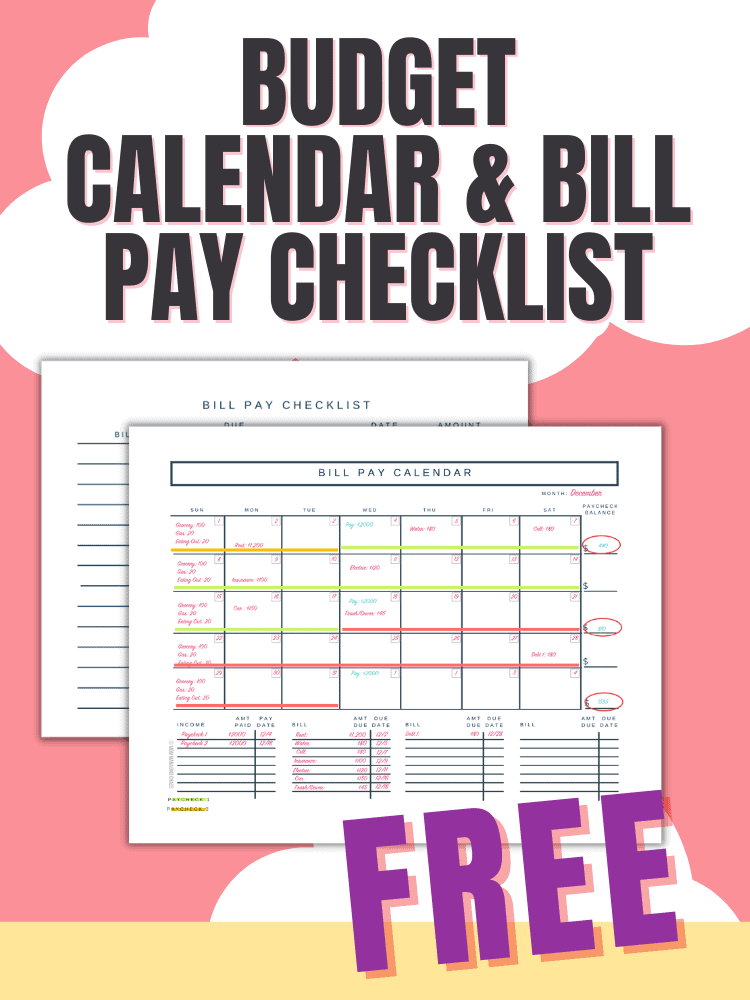
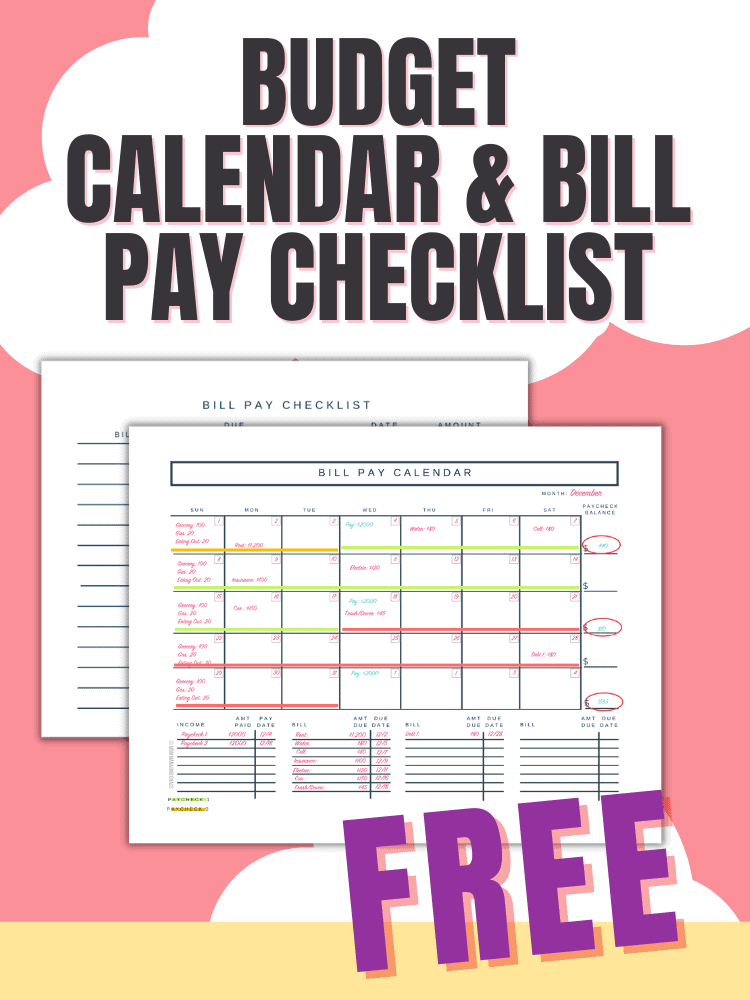
That’s exactly what my free Budgeting Calendar does. You’ll map out which bills get paid with which check, and which ones get the weekly slice, so nothing sneaks up on you and late fees become a thing of the past. Over 36K busy budgeters are already using it (come join us!).
DON’T MISS IT!
Drop your email address below to grab your free Budgeting Calendar and join a community of 36K other busy budgeters!
By entering your email address, you are agreeing to our Privacy Policy and European users agree to the data transfer policy.
Weekly, Biweekly, or Monthly: Does the Method Change?
The method stays the same, and that’s the beauty of budgeting by paycheck. You plan the check in front of you, one payday at a time. The whole month takes care of itself.
Paid every other week instead? Biweekly earners get 26 checks a year, and two bonus-check months, so the same tricks apply (with bigger slices!).
And if the bigger goal is breaking the paycheck-to-paycheck cycle for good, head here next: stop living paycheck to paycheck.
Your First Weekly Paycheck Budget Won’t Be Perfect (Do It Anyway)
Mama, I’m here to tell you: your first weekly budget is going to be a rough draft. The second one gets a little better. By the fourth or fifth check, you’ll know your numbers by heart, and the whole thing takes ten minutes on payday.
That’s the hidden gift of weekly pay: 52 fresh starts a year. Stumble this week? It’s ok. Keep going. A brand new check and a brand new plan are only days away.
You’ve got this. One check at a time..


