
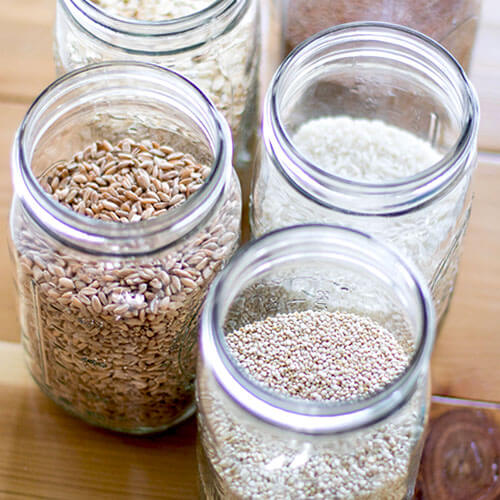
Fluffy, buttery, the perfect side dish for everything from your favorite chili recipe to a breakfast hash, cooking whole grains like rice and quinoa is easy… and worth doing the *right* way! Including a grain cooking chart, here’s how to soak and cook whole grains to aid digestion, boost nutrition, and even halve cooking time!

Table Of Contents
Why Soak Grains?
Do you know why grains should be soaked overnight — prior to cooking?
Not only does soaking reduce cooking time, but it also aids in digestion!
How? Well, grains are seeds that contain enzyme inhibitors and anti-nutrients such as phytic acid. The basic step of soaking the grain in warm water and an acid (like raw apple cider vinegar or lemon juice) for a minimum of 7 hours neutralizes some or most of the phytic acid.
Both the soaking and the cooking deactivate enzyme inhibitors for whole grains, while cooking deactivates them in cracked or rolled grains. This is great because we need enzymes in order to properly digest the foods we eat.
This basic recipe can be applied to cook many grains, whether whole, cracked or rolled.
Here’s my review of the VitaClay cooker, and how it makes gorgeous soaked and cooked grains!
Ingredients
- Grain of choice – These can be whole, cracked or rolled.
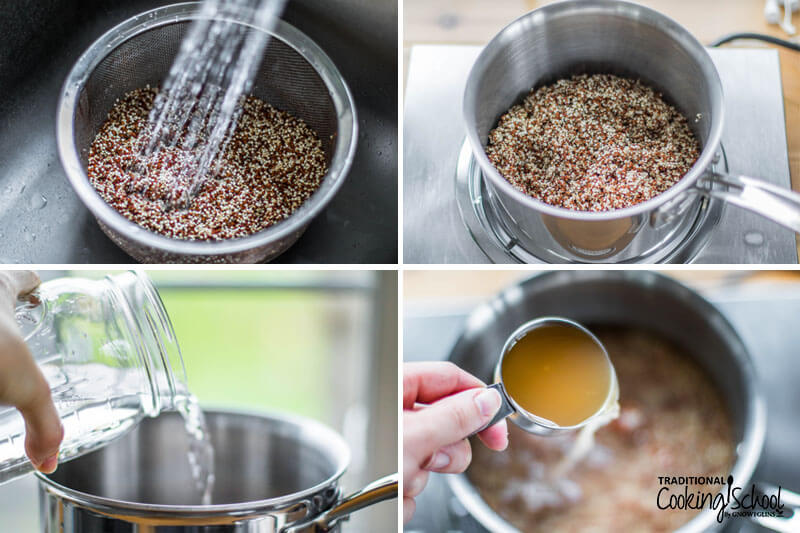
- Pure water – Choose filtered water free of contaminants. Warm water is best! You may also replace half of the water called for in the Grain Cooking Chart, below, with homemade broth or stock.
- Acid of choice – You may use Kombucha, raw apple cider vinegar, lemon juice, buttermilk, milk kefir, water kefir, whey, yogurt… even your sourdough starter in a pinch!
- Healthy fat – Although optional, we love adding a traditional fat such as grass-fed butter, lard, ghee, olive oil, or coconut oil to our soaked and cooked grains. It boosts flavor and nutrition!
- Sea salt – This is also optional, but highly recommended. Choose a mineral-rich salt if possible.
Soaking Grains
- First, choose your grain. The Grain Cooking Chart below tells you the amount of water required to cook (and soak) all grains, along with the cooking time. Please note that the cooking time listed is how long it takes to cook unsoaked grains; usually soaked grains take about half the time for cooking.
- Rinse the full amount of grain, if necessary (or desired).
- In the pot for cooking, combine the grains and the full amount of warm water along with an acid, such as Kombucha, raw apple cider vinegar, lemon juice, buttermilk, kefir, whey, yogurt, etc.
- Start the soaking the night before, so the grains will soak for at least 7 to 8 hours. Keep the mixture warm (in the oven with the light turned on should be just fine).
Cooking Whole Grains
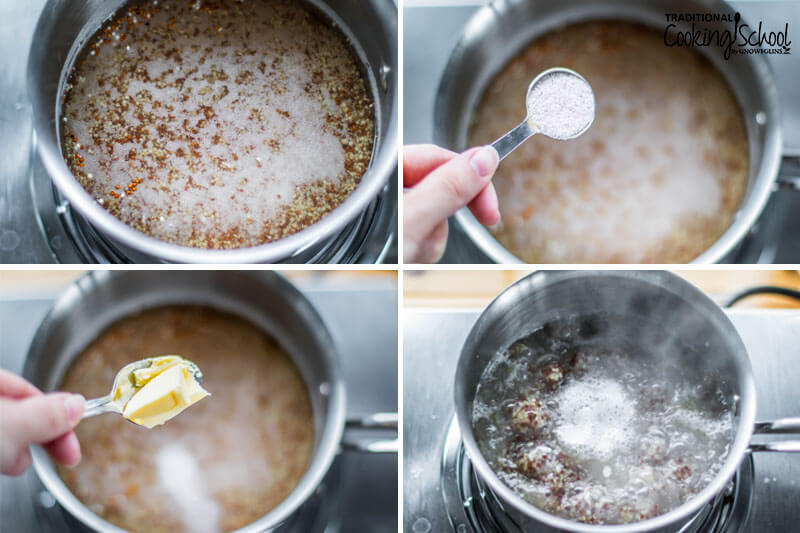
- After the soaking time has passed, you may drain the water, if desired. This is optional, however, to reduce the sour taste, some prefer to drain and rinse the grains, then replace the amount of water that was drained.
- Add a traditional fat and sea salt.
- Bring to a boil. Reduce heat to low and cover. Do not lift the lid during cooking time, except very quickly once or twice to make sure it is simmering gently.
- The grains are done when all the liquid is absorbed and they are quite tender, which is usually about half the time normally required for cooking dry whole grains.
- When done, turn off the heat and remove the pot from the burner.
- Let sit for 10 minutes, covered. Fluff with a fork.

Choosing The Right Acidic Medium For Soaking
You have many options when it comes to soaking whole grains in an acidic medium! Any of these can be used: white vinegar, raw apple cider vinegar, whey, lemon juice, kombucha, water kefir, milk kefir, buttermilk, yogurt, clabbered milk and even sourdough starter.
In fact, any fermented beverage or soured dairy should work because of the proliferation of lactic acid-producing bacteria. Choose one based on your needs.
- Need dairy-free? Go with raw apple cider vinegar, lemon juice, Kombucha, water kefir or sourdough starter.
- Want to increase the soaking power of your acidic medium? Choose a biologically active acid: raw apple cider vinegar with the mother, Kombucha, water kefir, milk kefir, buttermilk, yogurt, sourdough starter, etc.
- Your family complains about the sour taste of soaked whole grains? Choose whey, Kombucha or water kefir for a less sour taste.
The bottom line is that you can pick and choose, depending on what you have in your pantry at any given time, and your family’s preferences! Play around with it until you find what works for you.
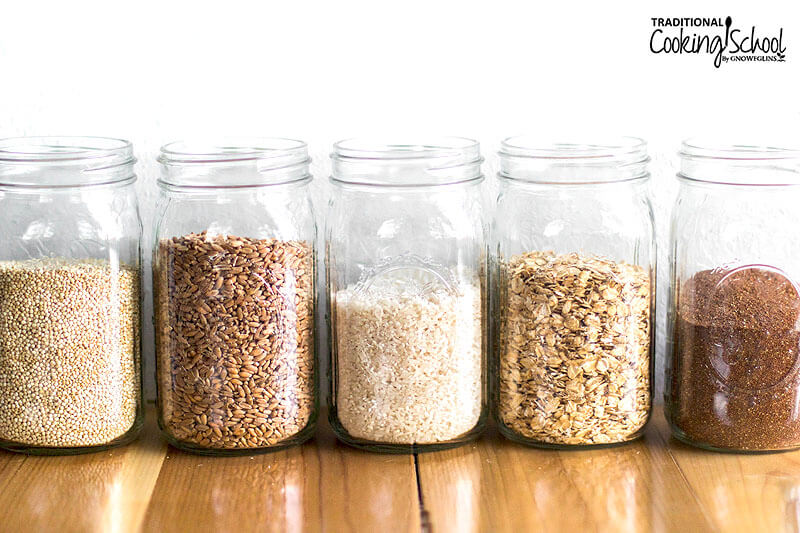
Grain Cooking Chart… Including Gluten-Free Grains!
information from “Enchanted Broccoli Forest” by Mollie Katzen
| RICE (1 cup) | WATER | COOKING TIME | YIELD |
| ^Brown Rice (long grain) | 2 cups | 35 to 45 minutes | 3 1/2 cups |
| ^Brown Rice (short grain) | 2 cups | 35 to 45 minutes | 3 3/4 cups |
| ^Brown Basmati Rice | 2 cups | 45 to 50 minutes | 4 cups |
| ^Brown Jasmine Rice | 2 cups | 45 to 50 minutes | 4 cups |
| ^Black Japonica Rice | 2 cups | 45 minutes | 3 1/2 cups |
| ^Wehani Rice | 2 cups | 45 minutes | 3 cups |
| ^Wild Rice | 2 1/2 cups | 1 1/4 hours | 4 cups |
| ^Manitok Wild Rice | 2 1/2 cups | 50 to 60 minutes | 4 cups |
| GRAIN (1 cup) | WATER | COOKING TIME | YIELD |
| ^Amaranth** | 1 1/2 cups | 25 minutes | 2 cups |
| Barley, Hulled | 3 cups | 1 3/4 hours | 4 cups |
| Barley, Pearl | 2 cups | 1 1/2 hours | 4 cups |
| ^Buckwheat/Kasha | 1 1/2 cups | 10 minutes | 3 1/2 cups |
| Bulgur* | 1 1/2 cups | 30 to 40 minutes | 3 cups |
| Cracked Wheat | 2 1/2 cups | 7 to 10 minutes | 3 1/2 cups |
| ^Cornmeal (Polenta) | 2 1/2 cups | 10 minutes | 3 1/2 cups |
| Couscous | 1 1/4 cups | 10 minutes | 2 3/4 cups |
| Kamut | 2 1/2 cups | 1 3/4 hours | 2 1/2 cups |
| ^Millet | 2 cups | 25 minutes | 3 1/2 cups |
| ^Oat Groats | 2 1/2 cups | 35 to 40 minutes | 2 1/2 cups |
| ^Quinoa** | 2 cups | 25 to 30 minutes | 4 cups |
| Rye Berries | 2 1/2 cups | 1 1/4 hours | 2 1/2 cups |
| Spelt | 1 1/2 cups | 50 to 60 minutes | 2 cups |
| ^Teff | 3 cups | 15 minutes | 3 cups |
| Triticale | 2 1/2 cups | 1 1/2 hours | 3 cups |
| Wheat Berries, Hard (Red) | 2 cups | 2 hours | 3 cups |
| Wheat Berries, Soft (White) | 2 cups | 1 1/2 hours | 3 1/2 cups |
*Soak, don’t cook. **Rinse first. ^Gluten-free (oats are gluten-free if purchased certified gluten-free).
Other Soaked Whole Grain Recipes
- Gluten-Free 4-Grain Breakfast Porridge (w/ easy soaking step!)
- How To Make Pre-Soaked Oats — NOT Rock-Hard Or Glued Together
- Perfect Soaked Rice {Instant Pot or any pressure cooker}
- Soaked Brown Rice Recipe (Baked & Stove Top Options!)
- Simple, Elegant Rice Pilaf
Did you try soaking your whole grains before cooking them? If so, please give us a rating on the recipe card below. Then snap a photo and tag us on social media so we can see!
How To Soak & Cook Whole Grains
Ingredients
-
grain of choice
see Grain Cooking Chart above for amount -
pure water
warm (see Grain Cooking Chart above for amount, specific to each grain) -
acidic medium of choice
1 tablespoon per 1 cup liquid (such as Kombucha, raw apple cider vinegar, lemon juice, buttermilk, kefir, whey, yogurt, etc.) -
traditional fat
1/2 tablespoon per 1 cup grain (such as grass-fed butter, olive oil, coconut oil, etc.) -
sea salt
1/4 to 1 teaspoon per 1 cup grain
Instructions
-
The night before, combine grains, water, and acid in a pot.
-
Cover pot and let sit out on counter for 7 to 8 hours, or overnight.
-
When ready to cook, add oil and salt.
-
Bring to a boil.
-
Reduce heat to low and cover. Allow to simmer for time listed (see chart below), or until grain is tender and all water is absorbed.
-
Don’t lift the lid while cooking, except very quickly once or twice to check that it is still simmering gently.
-
When cooked, remove from heat.
-
Let stand, covered, for about 10 to 15 minutes. Fluff with fork. Enjoy!
Recipe Notes
Broth or Stock Variation
- Soak the grain in half the amount of water called for in the cooking chart, plus 1 tablespoon of acid per cup of water used during this soaking step.
- The next day, add the other half of the water in the form of broth (no more acid is needed).
- Cook as the basic recipe describes, adding salt or oil as desired, using the half the cooking time suggested for that particular grain.
This post was originally published and written by Wardee Harmon on 7/6/09. It was updated and republished on 3/24/21.


