
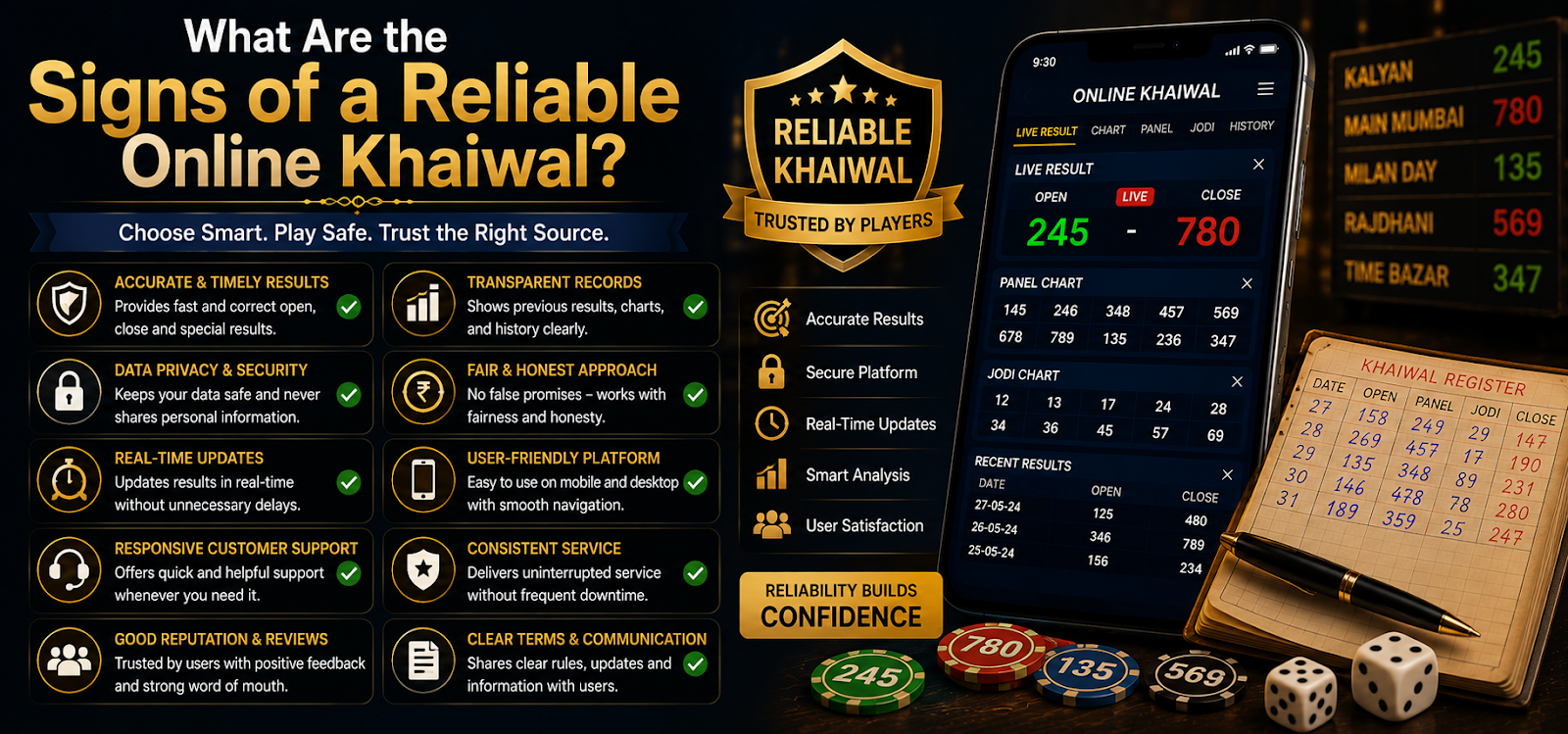
A reliable online khaiwal should be assessed through evidence rather than promises about fast results, high payouts, security, or fairness. Useful signs include identifiable operator information, transparent rules, verifiable authorization where required, clear payment conditions, secure account controls, accurate transaction records, privacy safeguards, and accessible dispute procedures. Responsible-gambling measures also matter because no betting platform can eliminate financial loss. Reliability does not mean guaranteed winnings or universal legality. Users should separately consider whether the activity is permitted in their location and whether the operator’s important claims can be independently verified before providing money or personal information.
Transparent Operator Information Is a Basic Trust Signal
Reliability starts with knowing who operates the service. A platform that handles money and identity information should not make basic operator details unnecessarily difficult to locate.
Users should be able to identify the entity responsible for accounts, payments, complaints, and data processing. Vague descriptions or anonymous ownership make accountability harder when something goes wrong.
Useful information may include:
-
The legal identity of the operator.
-
Relevant jurisdictional information.
-
Clear terms governing account use.
-
Privacy and data-handling information.
-
Formal channels for customer complaints.
-
Licensing details where authorization is required.
Transparency alone does not prove that every claim is accurate. However, an operator that refuses to identify itself gives users fewer ways to verify its statements or pursue a dispute.
Licensing Claims Should Be Verifiable
Betting and gambling laws vary between jurisdictions, so the word “licensed” needs context. A reliable operator should provide enough information for users to check any licensing claim rather than expecting them to accept a badge or statement at face value.
What a Licensing Claim Should Explain
A meaningful claim should identify:
-
The licence holder.
-
The issuing regulator.
-
The activity covered.
-
The territory covered.
-
Relevant licence identification where appropriate.
-
The current status of the authorization.
A foreign licence, if valid, does not automatically make participation lawful everywhere. Users need to consider both the operator’s authorization and the rules applying where they are located.
In India, legal treatment of gambling and betting can differ by state and activity. Internet availability should therefore never be interpreted as nationwide legal permission.
Clear Game Rules Reduce Ambiguity
Reliable online systems explain how their games operate before users commit funds. Rules should describe accepted formats, cut-off times, result procedures, stake conditions, payout calculations, and circumstances that could make an entry invalid.
For number-based formats such as Single, Jodi, Panna, Half Sangam, or Full Sangam, terminology should remain consistent throughout the platform.
Users should be cautious when rules appear incomplete, contradictory, or subject to unexplained changes. Important conditions should not emerge only after a disputed result or withdrawal request.
Clear rules also help distinguish an operational error from a misunderstanding. If a platform records entries digitally, users should be able to compare the submitted selection with the published conditions and subsequent result.
Digital Entry Records Should Be Easy to Review
A dependable account system should create clear records of relevant activity. Unlike traditional arrangements that may rely on handwritten slips or verbal confirmation, online systems can provide timestamps and transaction histories.
An entry record may reasonably show:
-
The relevant game.
-
Selected number or combination.
-
Stake amount.
-
Submission time.
-
Entry status.
-
Applicable result.
-
Resulting account movement.
Accurate records can help resolve disputes concerning timing, selections, or settlement.
However, users should retain important records independently where appropriate. Screenshots, payment confirmations, and transaction references can provide useful documentation if account information later becomes inaccessible.
Result Information Should Be Consistent and Traceable
Result publication is a central function of an online khaiwal. Reliability requires more than posting numbers quickly. Results should correspond clearly with the relevant game, schedule, and entry period.
Historical records should also remain internally consistent. Frequent unexplained corrections or conflicting results across different parts of the same platform can raise concerns.
Speed should never become the sole measure of credibility. A slower but clearly documented result process can provide more useful accountability than rapid publication accompanied by unexplained changes.
Users should also separate historical information from prediction. Previous results can document what occurred, but they cannot guarantee future outcomes. A service that uses past charts to promise certain winning numbers deserves strong skepticism.
RNG Claims Require Evidence Beyond Technical Language
Some online betting systems claim to use a random number generator, commonly abbreviated as RNG. An RNG is intended to generate unpredictable outcomes according to its design and implementation.
A platform should not be considered reliable merely because it displays the letters “RNG.” Users need context around the claim.
Fairness Claims Should Be Specific
Relevant questions include:
-
What process generates the result?
-
Is the claimed RNG independently tested?
-
Who performs any stated testing?
-
Can the testing information be verified?
-
How does the operator protect result integrity?
-
What happens when a technical error affects a draw?
Similarly, expressions such as “provably fair” require explanation. Technical terminology should correspond with a process that users can meaningfully assess rather than functioning as promotional decoration.
No fairness system can guarantee that an individual user will win.
Deposit Terms Should Be Clear Before Payment
Reliable platforms explain deposit procedures before users transfer funds. A user should know which payment methods are accepted, how transactions appear in the account, and what verification conditions may apply.
Payment instructions should remain consistent with published account procedures. Sudden requests to send money to unexplained destinations or communicate only through unofficial channels deserve caution.
Users should keep independent payment records. A platform balance is an internal accounting figure and should not automatically be treated as equivalent to money held in a regulated bank account.
Successful deposits also prove very little about withdrawal reliability. A questionable service may accept money easily while creating obstacles when a user tries to remove funds.
Transparent Withdrawal Rules Are Particularly Important
Withdrawal conditions often reveal more about reliability than deposit convenience. Users should examine these rules before placing money into an account.
Clear terms should explain verification requirements, available withdrawal methods, processing procedures, disclosed fees, and circumstances that could restrict a request.
Warning signs include:
-
New conditions appearing only after a withdrawal request.
-
Unexplained processing charges.
-
Demands for another deposit to release existing funds.
-
Repeated account blocks without written reasons.
-
Requests for passwords or one-time codes.
-
Pressure to pay supposed taxes directly to an unknown person.
-
Constantly changing withdrawal instructions.
A reliable service should not depend on confusing financial conditions that users could not reasonably review beforehand.
KYC and Age Verification Should Have a Clear Purpose
Know Your Customer, or KYC, procedures may help verify identity and age and can support fraud prevention or regulatory obligations where applicable.
A reliable operator should explain why particular information is required rather than requesting unlimited personal documents without context.
Users should consider whether:
-
Verification requirements appear in published policies.
-
Document requests are proportionate to their stated purpose.
-
Privacy information explains data use.
-
Secure methods exist for submitting sensitive information.
-
The operator provides procedures for account verification problems.
KYC terminology does not establish legitimacy by itself. Fraudulent services can imitate regulatory language, so identity checks should be considered alongside operator information, licensing, security, and payment transparency.
Privacy Practices Should Protect Sensitive Information
Digital betting accounts may contain names, contact details, payment information, transaction histories, and identity documents. Consequently, privacy deserves serious attention.
A clear privacy policy should explain what information the operator collects, why it collects it, how it uses the data, and how users can raise privacy concerns.
Users should be wary of unnecessary document requests, unclear data-sharing practices, or pressure to transmit sensitive information through informal messaging channels.
Privacy and security also need to work together. A well-written policy offers limited protection if weak technical controls expose user accounts. Likewise, strong encryption cannot compensate for irresponsible collection or handling of personal information.
Account Security Should Go Beyond an SSL Symbol
Secure web connections are useful because encryption can help protect information transmitted between a user and a server. However, an SSL indicator does not prove that the business behind the website is trustworthy.
Reliable account security may include strong password controls, multi-factor authentication, suspicious-login monitoring, protected account recovery, and procedures for reporting unauthorized activity.
Users should also practice basic security:
-
Create a unique password.
-
Enable additional authentication where available.
-
Avoid unexpected login links.
-
Never disclose one-time passwords.
-
Keep devices updated.
-
Review unfamiliar account activity promptly.
-
Refuse requests for remote access to a device.
Impersonated customer support can be particularly dangerous. Legitimate support processes should not require a user’s password or authentication code.
Transaction Histories Should Provide Financial Clarity
A useful online account should show how money moves through the system. Deposits, withdrawals, stakes, settlements, refunds, and other adjustments should be identifiable rather than appearing as unexplained balance changes.
Transaction histories can also help users monitor their own spending. Digital balances sometimes make losses feel less tangible than physical cash, especially when repeated deposits occur over a short period.
Users should periodically compare platform records with independent payment statements. Differences should be investigated rather than ignored.
Reliable records do not make gambling financially safe, but they provide greater transparency and can make disputes easier to document.
Customer Support Should Be Accountable
Reliable support does more than answer general questions. It should provide a structured way to address payment issues, verification problems, incorrect account records, security incidents, and disputed restrictions.
Users should know how to submit a complaint and what information they need to provide. Important decisions should receive a clear explanation rather than vague instructions to deposit more money or wait indefinitely.
Dispute Procedures Matter
A useful dispute process should clarify:
-
How complaints are submitted.
-
What records users should provide.
-
How account issues are reviewed.
-
How decisions are communicated.
-
Whether escalation is available.
Users should retain relevant correspondence. Written records can become particularly valuable when a disagreement concerns a withdrawal, account suspension, or disputed transaction.
Responsible-Gambling Controls Indicate Better Risk Awareness
A reliable operator should acknowledge that betting can cause financial and behavioral harm. Promoting wagering as dependable income conflicts with responsible risk communication.
Useful controls may include spending limits, deposit limits, cooling-off periods, self-exclusion, transaction histories, and access to information about gambling-related harm.
Users should establish personal boundaries regardless of platform controls:
-
Never wager money needed for essential expenses.
-
Avoid borrowing for gambling.
-
Do not increase stakes to recover losses.
-
Monitor total deposits rather than isolated wins.
-
Take breaks from repeated participation.
-
Seek professional help if gambling becomes difficult to control.
No responsible-gambling feature eliminates financial risk. These tools create boundaries; they do not convert betting into a safe earning method.
Reliable Platforms Avoid Guaranteed-Profit Claims
Promises of guaranteed winnings are among the clearest warning signs in chance-based gambling. No operator can responsibly guarantee that a participant will earn money from an uncertain outcome.
Users should be particularly cautious about claims involving:
-
Guaranteed winning numbers.
-
Fixed results.
-
Certain daily earnings.
-
Secret prediction formulas.
-
Risk-free wagers.
-
Assured recovery of previous losses.
-
Paid insider results.
Historical charts cannot establish certainty about future random outcomes. Similarly, a claimed algorithm, expert prediction, or special access arrangement should not be treated as proof of future winnings.
A reliable service communicates financial risk plainly rather than creating unrealistic expectations.
Reliability and Legality Are Different Questions
A platform can have a polished interface, detailed records, strong security, and responsive support while still raising legal questions in a particular jurisdiction.
Users should therefore assess legality separately from technical quality. The relevant factors may include the user’s location, the nature of the activity, the operator’s location, and applicable authorization requirements.
This distinction matters particularly in India because gambling and betting regulation can vary between states and activities.
Users should not assume that KYC, AML terminology, encrypted payments, or a licensing badge resolves every legal issue. Anyone uncertain about the applicable rules should seek qualified legal advice before participating.
A Practical Reliability Checklist
No single feature proves that an online khaiwal deserves trust. A stronger assessment combines legal, financial, operational, technical, and responsible-gambling indicators.
Before providing money or identity information, consider whether:
-
The operator can be identified.
-
Licensing claims can be checked where relevant.
-
Local participation appears legally permitted.
-
Game rules are available before entry.
-
Results follow clearly stated procedures.
-
Deposit conditions are transparent.
-
Withdrawal rules are visible beforehand.
-
Transaction records are accessible.
-
Privacy practices are clearly explained.
-
Account security is meaningful.
-
KYC requests have a stated purpose.
-
Complaints follow a documented process.
-
Responsible-gambling controls exist.
-
The operator avoids guaranteed-profit claims.
A platform that performs well in one area can still have serious weaknesses elsewhere. Reliability should be judged across the entire operation rather than through a single badge, feature, testimonial, or marketing statement.
FAQs
What makes an online khaiwal appear reliable?
Useful indicators include identifiable ownership, clear rules, verifiable licensing where required, transparent deposits and withdrawals, accurate account records, meaningful security, privacy information, and structured dispute procedures. Responsible-gambling controls also matter. No individual feature proves reliability, so users should assess these factors together rather than trusting promotional claims.
Does a gambling licence automatically prove reliability?
No. A valid licence can provide relevant regulatory information, but users should verify who issued it, what activity it covers, where it applies, and whether it remains current. Licensing also does not guarantee winnings or make participation lawful in every location. Local legal requirements still need separate consideration.
Is SSL enough to prove an online platform is secure?
No. Encryption can protect information while it travels between a browser and server, but it does not establish operator legitimacy, fair results, financial stability, or responsible data handling. A stronger security assessment includes authentication, account recovery, privacy practices, suspicious-activity controls, and safe procedures for handling payment and identity information.
Why are withdrawal rules a major reliability signal?
Withdrawal rules reveal how an operator handles users who want to remove eligible funds. Clear conditions should be available before deposits occur. Unexpected fees, demands for additional deposits, unexplained account restrictions, changing requirements, or requests for passwords and authentication codes can indicate serious financial or security concerns.
Does KYC mean an online khaiwal is legitimate?
Not necessarily. KYC can support identity verification, age checks, fraud prevention, or regulatory obligations, but questionable operators can also use compliance terminology. Users should separately verify operator identity, licensing claims, payment terms, privacy safeguards, and legal status. Sensitive documents should only be provided after considering how they will be handled.
How can users assess claims about RNG fairness?
Users should look beyond an operator’s statement that an RNG exists. Relevant considerations include how the result process works, whether testing is independently performed, whether verification information can be checked, and how technical errors are addressed. An RNG claim does not guarantee that implementation is fair or that users will win.
Are fast results a sign of a reliable platform?
Fast publication can improve convenience, but speed alone says little about reliability. Results should remain consistent, correspond with stated schedules, and follow clearly described procedures. An operator that publishes rapidly but repeatedly changes outcomes without explanation may provide less confidence than a system with transparent and traceable result handling.
What payment warning signs should users avoid?
Warning signs include unexplained payment destinations, extra deposits demanded before withdrawals, hidden charges, requests for one-time passwords, pressure to transfer money immediately, and instructions that conflict with published terms. Users should keep independent transaction records and examine withdrawal requirements before sending funds rather than waiting until a dispute arises.
Can a reliable online khaiwal guarantee profits?
No. Reliability cannot remove the uncertainty of gambling. Claims involving guaranteed profits, fixed winning numbers, certain loss recovery, or risk-free earnings deserve skepticism. Even a technically secure and properly operated betting system can produce financial losses. Users should never treat wagering as a dependable method of generating income.
Why should responsible-gambling features affect reliability?
Responsible-gambling controls show whether an operator acknowledges financial and behavioral risks rather than presenting wagering purely as an earning opportunity. Spending limits, cooling-off periods, self-exclusion, and transaction visibility can support safer boundaries. These measures cannot eliminate gambling harm, but their absence may reveal weak attention to user protection.


