
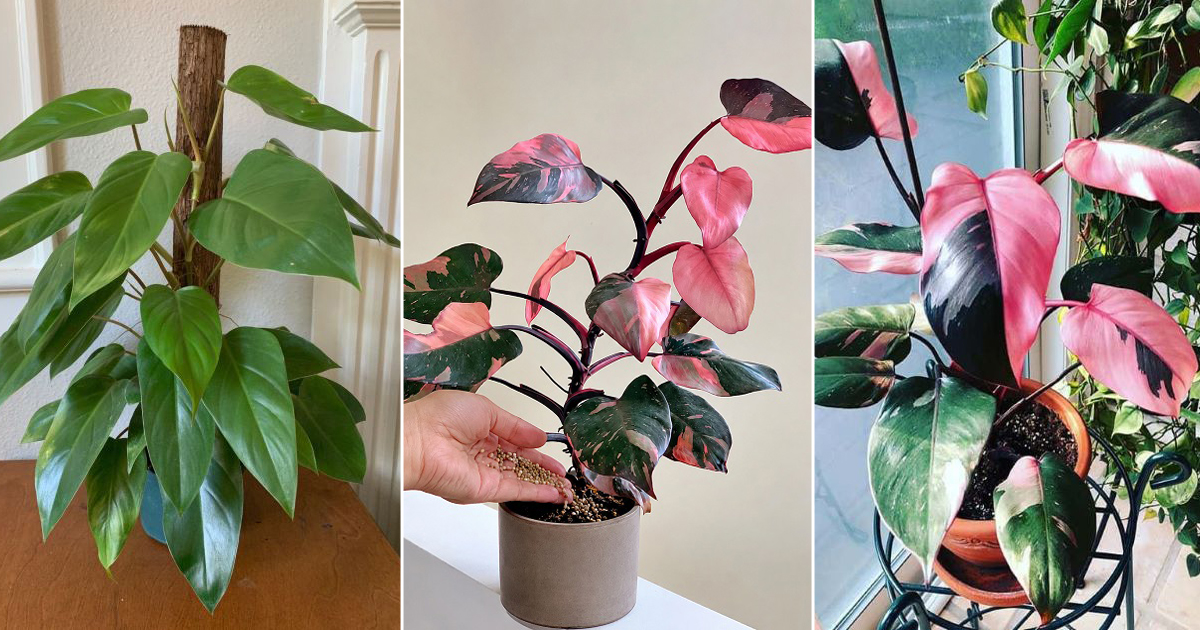
Is your Pink Princess Philodendron losing its pink color? Here are the reasons behind the fading and what to do!

If your Pink Princess seems to be losing its signature color, don’t rush to change everything about your care routine. A few closer observations can tell you exactly what’s happening. Once you understand how it produces variegation, you’ll have a much better chance of encouraging stronger pink growth again.
Reasons for Pink Princess Philodendron Losing Color and How to Fix It
1. Pay Attention to the Stem

Take a close look at the stem between the nodes. If you can see pink streaks, burgundy marbling, or patches of lighter tissue running through it, there is still plenty of potential for colorful new growth.
On the other hand, if an entire section of stem has become solid green, the leaves emerging from that area are likely to become greener as well.
The Fix: Since green tissue produces more energy than pink tissue, the plant often begins favoring greener growth over time. Regular pruning of green growth helps interrupt that process. More growth points = more attractive variegation.
A pair of sharp pruning snips makes the cutting easier and helps prevent unwanted damage to the plant.
2. Too Much Fertilizer Works Against You

Most growers worry about underfeeding their plants, but overfeeding can create its own problems. A Pink Princess relies on green tissue to generate energy, and heavy nitrogen feeding often encourages the plant to produce more chlorophyll-rich growth.
This doesn’t mean fertilizer directly removes pink coloration. Instead, it pushes the plant toward rapid growth, and rapid growth tends to favor the tissues that are most efficient at photosynthesis.
The Fix: A balanced feeding schedule! You want steady, healthy growth rather than a race to produce the largest number of leaves possible. Look for a formula close to 3-1-2, or 10-10-10, or 20-20-20 diluted to half strength during active growth. Here is our complete guide on growing one of these like a master gardener.
This 100% pure organic mineral-dense worm castings fertilizer improves soil fertility and aeration for better growth.
3. There’s No Temperature Stability

Many care guides mention temperature only when discussing survival, but temperature can also influence coloration. The pink shades in a Pink Princess come from pigments called anthocyanins.
When temperatures fluctuate dramatically between day and night, those pigments may not develop as strongly in new leaves. The plant can still grow perfectly well, but the colors may appear weaker, muddier, or less vibrant.
What to do? Just keeping your plant away from drafty windows, air-conditioning vents, radiators, and sudden temperature swings often produces more consistent growth. Stable conditions give developing leaves the best chance to express their natural coloration!
A soil moisture meter makes the job much easier. If you don’t already have one, this is the moisture meter that we recommend. It is a 4-in-1 device that also helps you detect plant temperature.
4. The Moss Pole Could Be Turning Your Plant Green

People add a moss pole to make their Pink Princess climb, but mature climbing growth often produces larger leaves with more chlorophyll. In nature, once a Philodendron begins to reach higher in the canopy, its priority shifts toward maximizing energy production.
The result? Bigger leaves, faster growth, and sometimes less dramatic pink variegation.
Here’s what to do! If your plant has become very tall and green, don’t be afraid to trim and propagate the top section. Many growers notice that fresh juvenile growth often produces stronger variegation than aging vines that have been climbing for years.
Pro Grower Trick: Before pruning, mark the pinkest leaf your plant has produced in the last six months. Then trace that leaf back to its node on the stem. That’s usually the exact section you want to preserve when pruning.
5. The Plant Is Producing “Survival Leaves”

Sometimes a Pink Princess pushes out leaves that look disappointingly green after repotting, shipping stress, pest damage, or root disturbance. These are often survival leaves. The plant temporarily prioritizes energy production over appearance.
Because pink tissue doesn’t contribute much to photosynthesis, the plant intentionally leans greener until it feels secure again.
The Fix: Don’t judge the plant by the first one or two leaves after a stressful event. Wait for three to four new leaves before deciding whether there’s a true variegation problem. Then, try to fix it! Maybe spruce up your home by redecorating the space with your philodendron this way.
Bonus Trick: Give It More Light Than You Think It Needs
Many growers are surprised to learn that exposure to more indirect light is often the difference between a mostly green plant and one covered in pink patches.
If your Pink Princess has been fading, simply moving it closer to a bright window or providing a quality grow light will help future leaves emerge with stronger color.
An east-facing window is often ideal for this, as it provides gentle morning sun followed by bright light for the rest of the day. A few feet back from a south-facing window can also work well, provided the leaves are protected from harsh afternoon rays with a curtain!
The key is to focus on the plant’s growth patterns rather than just the leaves. Once you understand what your Pink Princess is trying to tell you, bringing back better color becomes much easier.


