
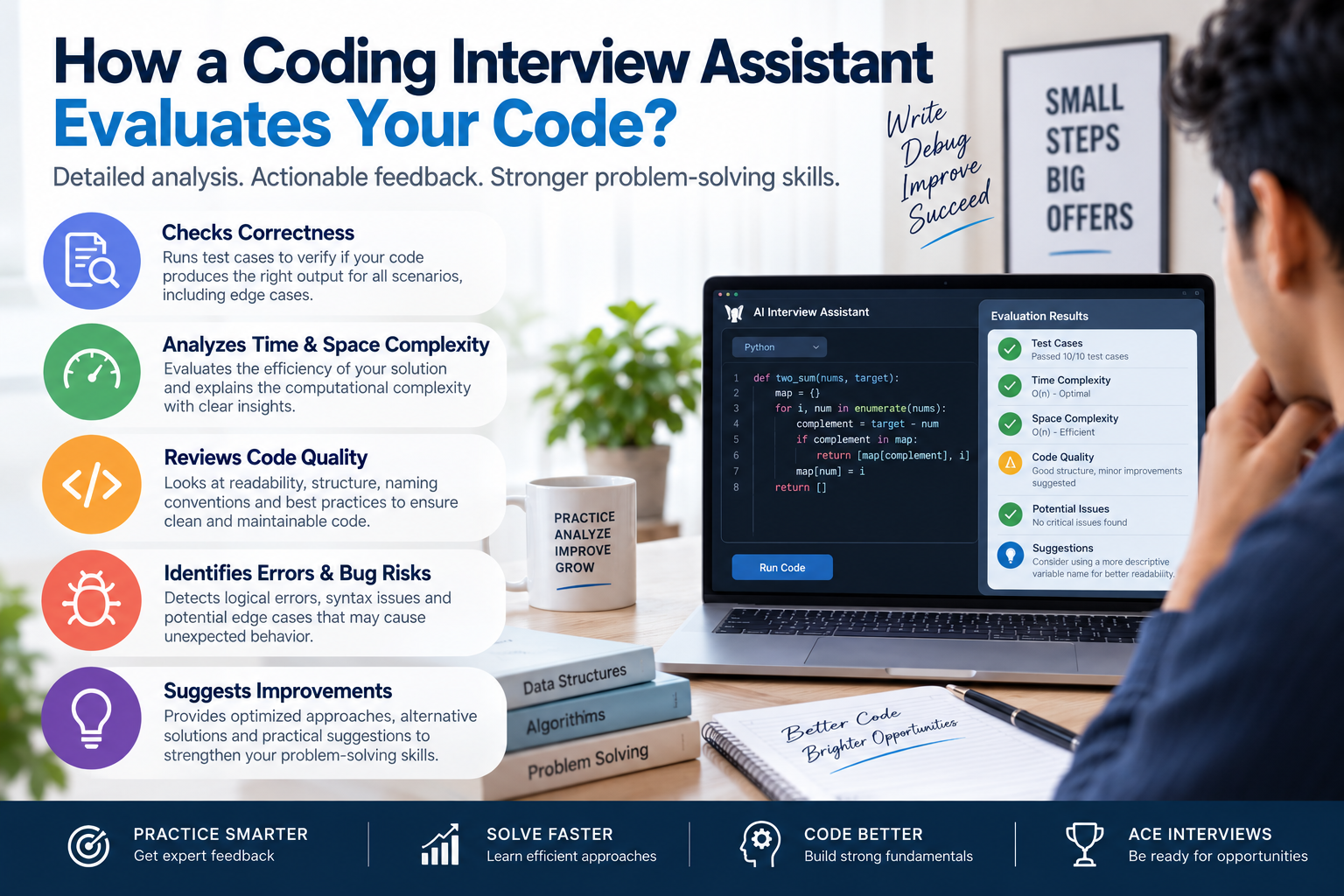
A coding solution can run successfully and still be weak in an interview setting. Evaluation often considers whether the program solves the full problem, handles edge cases, uses suitable algorithms, manages resources sensibly, and communicates intent through readable code. Depending on its capabilities, an automated assistant may inspect source code, execute tests, estimate complexity, flag defects, or comment on structure. Yet code evaluation is never only about producing one correct output. Strong assessment also considers reasoning, trade-offs, debugging decisions, and whether the candidate can explain why the solution works.
What a Coding Evaluator Actually Checks
A coding evaluator examines several dimensions beyond whether a program runs. Depending on the environment, it may inspect syntax, execute tests, compare outputs, detect failures, estimate efficiency, and review code organisation.
Typical evaluation areas include:
-
Correctness against stated requirements and expected outputs.
-
Syntax, compilation, interpretation, and runtime behaviour.
-
Coverage of edge cases and boundary conditions.
-
Time and space complexity relative to problem constraints.
-
Data structure and algorithm choices.
-
Readability, naming, duplication, and modularity.
-
Error handling, input treatment, and output formatting.
-
Reasoning quality when explanations or interactive practice are available.
An AI interview assistant for coding may combine several of these signals, although no system should be assumed to perform every check automatically. Some tools inspect text without executing it, while others operate inside an environment that can compile and run submissions.
Code inspection can suggest likely problems, whereas execution can confirm specific failures. Accordingly, candidates should interpret feedback according to what was actually evaluated.
A Typical Code Evaluation Sequence
Evaluation workflows differ, yet many systems follow a broadly similar sequence.
A typical process may look like this:
-
Read the problem statement and identify input, output, and constraints.
-
Parse, compile, or prepare the submitted program for execution.
-
Check whether syntax or language rules prevent execution.
-
Run sample or visible test cases where available.
-
Run additional evaluation cases, including hidden cases in some environments.
-
Compare actual results with expected outputs.
-
Detect exceptions, crashes, timeouts, or other runtime failures.
-
Test edge conditions and unusual permitted inputs.
-
Estimate or analyse time complexity.
-
Consider memory usage and space complexity.
-
Review structure, naming, duplication, and control flow.
-
Produce feedback, improvement suggestions, or alternative approaches.
This sequence is not universal. A static reviewer may never execute code, while another environment may focus heavily on tests and resource limits. Therefore, candidates should separate verified outcomes from inferred observations.
How Correctness Gets Evaluated
Correctness means satisfying the stated problem across permitted inputs, not merely matching one example. A sample may pass even when empty, duplicated, negative, or unusually large values fail.
Evaluators may check whether loops terminate, indexes stay within bounds, conditions cover all required branches, and data types can represent expected values. Similarly, recursive solutions need valid base cases; otherwise, they may recurse indefinitely or exhaust available stack space.
Requirements Matter More Than Familiar Patterns
Candidates may quickly recognise a familiar algorithm. However, small wording differences can change what counts as correct, such as preserving order, returning indexes, or treating duplicates differently.
A careful evaluator therefore compares behaviour with the exact specification. It may check:
-
Required return type or output format.
-
Treatment of empty or minimum-sized input.
-
Behaviour at upper constraint limits.
-
Duplicate, negative, or repeated values where relevant.
-
Off-by-one boundaries in loops or slices.
-
Risks of division, overflow, or invalid operations.
-
Base cases for recursive logic.
Consequently, translating the statement into explicit conditions before coding reduces the chance of solving the wrong problem.
How Test Cases Reveal Hidden Problems
Test cases provide concrete evidence about program behaviour by comparing actual results with expected outcomes. However, different test categories serve different purposes.
Sample cases illustrate requirements. Candidate-created tests challenge assumptions, while edge-case tests target boundaries or unusual combinations. Some environments also use hidden tests that candidates cannot see beforehand.
Why Passing Samples Is Not Enough
Visible examples rarely represent every legal input. A solution may work for positive integers yet fail for negative values, or handle several items but break on zero or one.
Useful test categories include:
-
Typical cases representing ordinary inputs.
-
Minimum and maximum permitted sizes.
-
Empty input when the specification permits it.
-
Duplicate or repeated values.
-
Negative, zero, or extreme numeric values where relevant.
-
Already sorted or reverse-ordered sequences.
-
Inputs that trigger rare conditional branches.
Hidden tests, where used, can expose assumptions that samples never challenge. Nevertheless, candidates should treat the stated constraints as the real contract and design their own tests accordingly.
Syntax, Compilation, and Runtime Failures
Before evaluating algorithmic quality, a system may need successful execution. Syntax, type, or symbol errors can stop the program before meaningful tests begin.
Compiled and interpreted languages can surface failures at different stages, depending on the language and runtime.
Runtime problems include exceptions, stack exhaustion, invalid operations, unexpected null values, and infinite loops. Additionally, excessive work may trigger an execution limit.
A diagnostic may identify where a failure surfaced rather than where the underlying mistake began. Therefore, candidates should trace state, assumptions, and control flow instead of fixing only the symptom.
A repeatable debugging process should reproduce the failure, isolate its cause, test the correction, and check for regressions.
How Time Complexity Affects Evaluation
Time complexity describes how work grows with input size. Big O notation expresses that growth without focusing on exact processor speed.
Common patterns include:
-
O(1): work remains roughly constant as input grows.
-
O(log n): work grows slowly, often by repeatedly reducing the search space.
-
O(n): work grows broadly in proportion to input size.
-
O(n log n): common in efficient comparison-based sorting and related strategies.
-
O(n²): work can grow quickly, often through nested processing over the same collection.
A correct O(n²) solution may suit small inputs yet become unsuitable at much larger scales.
Constraints Determine Whether Optimisation Matters
No complexity class is automatically better. A simpler algorithm may suit small constraints, limited memory, or lower implementation risk.
Evaluation may consider:
-
Maximum input size.
-
Expected execution time.
-
Number of repeated operations.
-
Chosen algorithm and data structure.
-
Cost of sorting, searching, or nested loops.
-
Recursive depth and repeated subproblems.
For example, a hash-based lookup may reduce repeated searches while consuming more memory. Accordingly, candidates should explain that trade-off.
How Space Complexity Gets Considered
Space complexity describes how additional memory grows with input size through arrays, maps, sets, recursion stacks, buffers, or copied data.
An in-place algorithm may use little extra storage, while another creates a second collection. Neither is automatically wrong; constraints, readability, and performance determine suitability.
Recursive algorithms deserve attention because active calls add stack usage. Deep recursion may hit environment limits, while caching can improve runtime by using more memory.
A coding evaluator may estimate space from source or measure memory when supported. However, candidates should still explain major allocations and justify the trade-off.
Code Quality and Readability Beyond Correct Output
Two solutions can produce identical outputs while differing in clarity. Readable code makes intent easier to inspect, debug, and discuss.
Quality review may consider:
-
Descriptive variable and function names.
-
Clear separation of responsibilities.
-
Functions that remain focused on one task.
-
Limited unnecessary nesting.
-
Consistent formatting and control flow.
-
Removal of repeated logic.
-
Comments that explain non-obvious reasoning rather than restating code.
-
Sensible decomposition into reusable parts.
Why Duplication and Naming Matter
Repeated logic creates more places to change and can produce inconsistent fixes. Extracting shared logic may improve maintainability when the abstraction remains clear.
Naming affects how quickly another person follows the solution. Descriptive names help when purpose persists, although short names can suit local indexes or familiar notation.
Readability involves subjective judgement. Therefore, automated style comments are not absolute rules, and conventions can vary by language or context.
Reasoning Is Different From Code Correctness
Executable code shows what the candidate implemented, but not fully why they chose that approach.
Interview preparation should therefore examine requirement interpretation, assumptions, edge cases, algorithm choice, debugging, and optimisation.
Explaining Trade-Offs Strengthens Evaluation
Explaining why a map replaces repeated scanning, or why an in-place approach saves memory, shows awareness of trade-offs.
Reasoning review may ask:
-
What assumptions does the solution rely on?
-
Why does the algorithm produce the correct result?
-
Which edge cases deserve special attention?
-
What are the time and space costs?
-
Could another approach improve one dimension while worsening another?
-
How would the solution change if constraints increased?
Automated systems may generate these prompts, but code alone cannot prove communication, collaboration, architectural judgement, or depth of experience.
Static Analysis Versus Actual Execution
Static analysis examines source code without running it and may identify suspicious constructs, unreachable logic, duplication, naming concerns, or complexity indicators.
Execution-based assessment runs the program with actual inputs and can reveal wrong outputs, exceptions, timeouts, infinite loops, or unexpected behaviour.
Why Combining Both Can Be Useful
Static inspection can flag unreachable branches or likely quadratic loops. However, such observations can produce false positives without runtime context.
Execution gives stronger evidence for specific inputs, yet a program can still contain an untested defect.
Therefore, some systems combine both methods. Candidates should distinguish an observed failed test from an inferred efficiency concern.
How Automated Feedback Suggests Improvements
AI-supported review may comment on bugs, complexity, readability, edge cases, and alternatives, such as replacing repeated searches with a faster lookup structure.
However, a technically correct solution can still receive improvement suggestions. Correctness answers whether the program meets requirements; quality feedback considers whether another implementation might be clearer, faster, simpler, or easier to maintain.
Candidates should evaluate suggestions against constraints. More memory may reduce runtime, while extra abstraction may add little value in a small interview problem.
Moreover, candidates should separate stylistic preferences from material defects. A suggestion to rename a variable may improve clarity, while a warning about an incorrect boundary condition concerns correctness. Treating both comments as equally serious can distort priorities. Strong review ranks feedback by impact, verifies the evidence, and then applies changes that suit the stated requirements.
Comparing two solutions can reveal different edge cases and trade-offs. Accordingly, feedback should prompt reasoning rather than demand automatic acceptance.
Limitations of Automated Code Evaluation
Automated evaluation can provide useful signals, but it cannot measure developer ability completely. Systems may misread intent, miss unusual edge cases, oversimplify complexity, or suggest changes that conflict with the problem’s actual constraints.
Common limitations include:
-
False positives that flag valid code as suspicious.
-
Missed defects in paths that were never executed.
-
Complexity estimates that ignore language or runtime details.
-
Limited awareness of interviewer-specific expectations.
-
Weak context about broader architecture or production constraints.
-
Difficulty comparing equally valid coding styles.
-
Incomplete handling of language-specific behaviour.
-
Environment-dependent differences in memory or execution.
-
Limited ability to assess communication, collaboration, and judgement.
Furthermore, small algorithmic exercises reveal only part of professional software engineering. They rarely capture long-term maintainability, system design, stakeholder communication, testing strategy, deployment concerns, or team collaboration.
Candidates should therefore treat automated feedback as evidence to investigate. When a suggestion seems questionable, they should verify it through reasoning, documentation, controlled tests, or discussion with a qualified reviewer.
Responsible Use During Interview Preparation
Using an assistant before an interview for practice, debugging, explanation, and feedback differs from using undisclosed real-time assistance during an assessment that requires independent work.
Candidates should follow the rules attached to each interview or coding exercise. Depending on the employer or assessment environment, outside tools may be permitted, limited, or prohibited.
Responsible practice includes:
-
Reading interview and assessment instructions carefully.
-
Following restrictions on external tools.
-
Protecting confidential prompts, employer information, and assessment materials.
-
Avoiding concealed assistance when independent performance is required.
-
Respecting academic or professional integrity expectations where relevant.
-
Asking for clarification when permitted resources are unclear.
Preparation should strengthen the candidate’s own coding and reasoning skills. If a system produces an answer, the candidate should still be able to explain, modify, test, and defend that solution independently. Otherwise, the practice has produced dependency rather than readiness.
FAQs
1. How does a coding assistant know whether code is correct?
It may compare program outputs with expected results across available test cases, inspect logic, or combine both methods. Correctness depends on satisfying the full specification, including relevant edge conditions. However, passing available tests cannot prove that every possible permitted input has been handled correctly overall.
2. Can coding assistants detect inefficient algorithms?
Some systems can estimate complexity by inspecting loops, recursion, data structures, and repeated operations. Others may observe performance during execution. However, efficiency depends on input constraints and runtime context, so an automated complexity warning should be reviewed alongside the problem requirements rather than accepted automatically.
3. What are hidden test cases in coding assessments?
Hidden tests are evaluation inputs that a candidate cannot see before submission. Where an assessment uses them, they can check boundary conditions, uncommon inputs, or assumptions not covered by examples. However, not every coding environment uses hidden tests, and candidates should rely primarily on the stated specification.
4. Can automated evaluation identify syntax errors?
Usually, syntax problems become visible during parsing, compilation, or interpretation, depending on the programming language and environment. A system may report the location and diagnostic message. However, the reported position can sometimes mark where parsing failed rather than the exact place where the underlying mistake began.
5. How are runtime errors evaluated?
When execution is available, a system may detect exceptions, crashes, invalid operations, timeouts, stack exhaustion, or other failures triggered by test inputs. Candidates should investigate the underlying state and control flow because the line where execution stops may represent the symptom rather than the original defect.
6. Does code readability affect technical evaluation?
Readability can influence how easily an interviewer or reviewer follows the solution. Clear naming, sensible functions, limited duplication, and readable control flow often support discussion. However, style contains subjective judgement, and formatting alone does not determine coding ability, correctness, or suitability for a software engineering role.
7. Can two different solutions both receive positive evaluations?
Yes. Many coding problems allow several correct approaches with different trade-offs in speed, memory, complexity, or readability. Evaluation should consider whether each solution satisfies the constraints and whether the candidate can justify the choice. A different algorithm is not automatically weaker simply because another solution exists.
8. How reliable is automated complexity analysis?
Reliability varies. Straightforward loops and common algorithmic patterns may be relatively easy to assess, while recursion, library calls, amortised operations, language behaviour, and data-dependent execution can complicate analysis. Candidates should verify complexity independently and explain their reasoning rather than treating an automated estimate as definitive.
9. Why can code pass tests and still receive improvement suggestions?
Tests mainly provide evidence about behaviour for specific inputs. A solution may pass them while containing unnecessary duplication, inefficient operations, unclear naming, or avoidable memory usage. Improvement feedback can therefore address maintainability and efficiency even when correctness appears satisfactory, although candidates should still evaluate whether each suggestion fits the task.
10. Is real-time coding assistance acceptable during an interview?
Acceptability depends on the employer’s instructions and assessment rules. Some interviews may permit external resources, while others require independent work. Candidates should never conceal prohibited assistance or bypass controls. When expectations are unclear, they should ask what resources are allowed before using any external support during the assessment.


